Alcohol Poisoning BAC Level
Authorities place the alcohol poisoning BAC level at about 0.35% to 0.40%, yet no single level is safe, and a 2020 forensic review calls the lethal threshold undefined. MedlinePlus warns that levels above 0.31% may be fatal, and in one Swedish series of 693 poisoning deaths, the lowest reading was 0.074%. If someone is very drunk now, the signs and the number to call are just below.
Call an ambulance on any single sign
If you think someone has alcohol poisoning, call for an ambulance now. The number is 911 in the US and Canada, 999 in the UK, 112 or 999 in Ireland, 000 in Australia and 111 in New Zealand. The National Institute on Alcohol Abuse and Alcoholism (NIAAA) overdose fact sheet says to call at once and not to hold off until the person shows every symptom. One sign is enough.
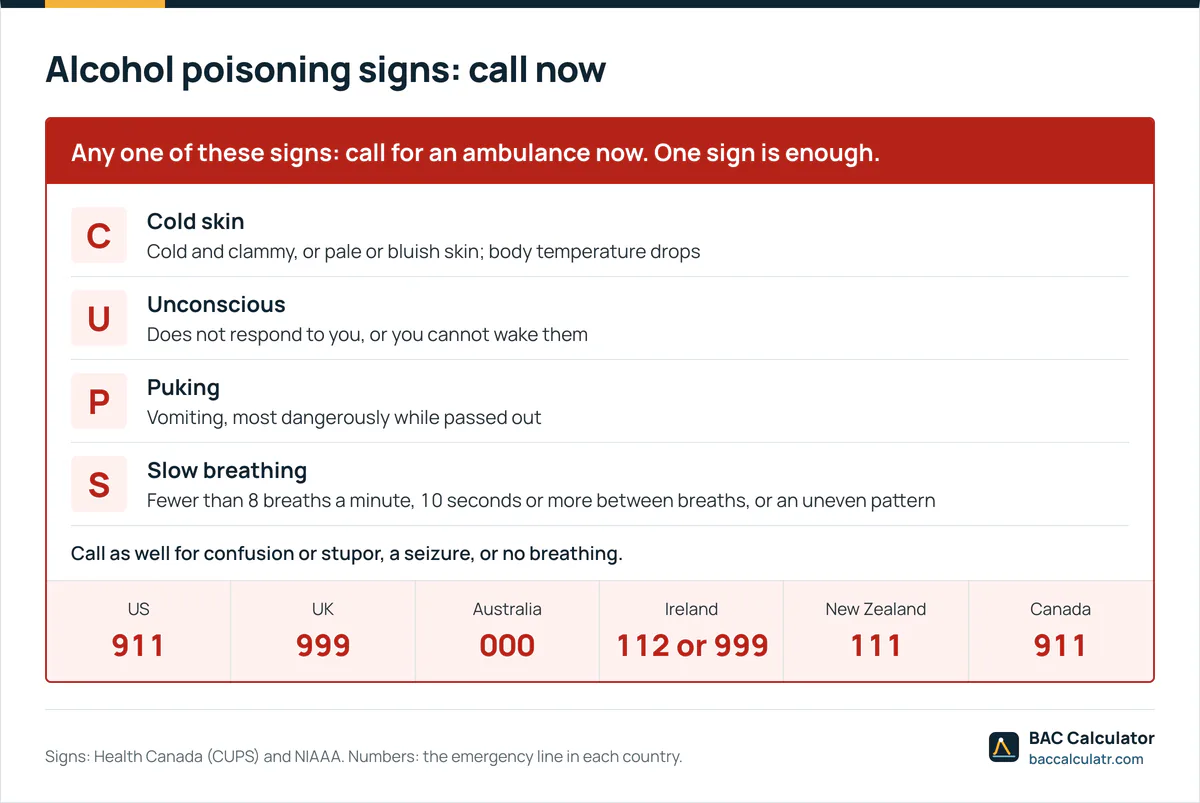
Health Canada sums up the signs as CUPS:
- C is for cold skin. The skin feels cold and clammy, or looks pale or bluish, and body temperature drops.
- U is for unconscious. They do not respond to you, or you cannot wake them.
- P is for puking. They are vomiting, most dangerously while passed out.
- S is for slow breathing. Fewer than 8 breaths a minute, 10 seconds or more between breaths, or an uneven pattern.
Call as well if they are confused or in a stupor, have a seizure, or stop breathing. Someone still awake can be in danger too, since NIAAA lists confusion and vomiting as overdose signs.
NIAAA warns that a person who has passed out can die. Their BAC can keep climbing after the last drink, even while they are out cold, as alcohol left in the gut still reaches the blood.
While you wait for help
Stay with the person the whole time, because they could fall or choke on vomit.
- Keep them on the floor, sitting up or half upright, not in a chair.
- If they vomit, have them lean forward so it comes out.
- If they pass out, roll them onto their side, one ear to the floor (the UK National Health Service (NHS) recovery position), and check their breathing.
- Cover them with a coat or blanket to keep them warm.
- Offer sips of water only if they are awake, can swallow and are not vomiting.
Alcohol poisoning BAC levels by range
Fatal alcohol poisoning BAC readings in autopsy studies cluster near 0.36%, but in one Swedish series they ran from just under the driving limit to above 0.60%. The table sets a BAC from a hospital test or a BAC calculator estimate against what each source recorded.
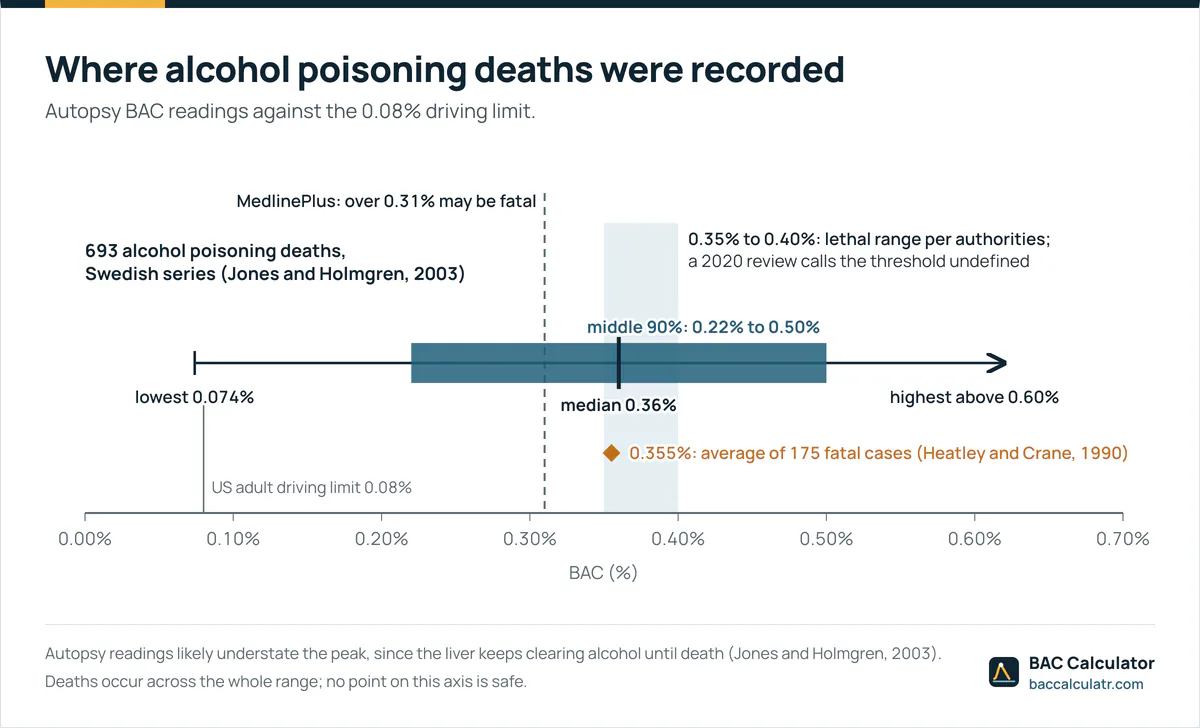
The comparisons use the 0.08% limit in every US state but Utah, which sets 0.05%. None of the sources predicts one person's outcome.
| BAC | What the source recorded | Against the 0.08% limit | Source |
|---|---|---|---|
| 0.074% | Lowest reading among 693 alcohol poisoning deaths in that Swedish series | Just below it (0.9 times) | Jones and Holmgren, 2003 |
| 0.16% to 0.30% | Serious intoxication; may pass out | 2 to 3.75 times as high | MedlinePlus (NLM) |
| 0.22% to 0.50% | Middle 90% of the same 693 deaths | 2.75 to 6.25 times as high | Jones and Holmgren, 2003 |
| Over 0.31% | Especially dangerous and may be fatal | Roughly 3.9 times or more | MedlinePlus (NLM) |
| 0.35% to 0.40% | Lethal range per authorities; the review calls it undefined | 4.4 to 5 times as high | Wang and colleagues, 2020 |
| 0.355% | Average in 175 fatal cases of acute alcohol intoxication | About 4.4 times as high | Heatley and Crane, 1990 |
| 0.36% | Average and median of the 693 Swedish deaths | 4.5 times as high | Jones and Holmgren, 2003 |
Autopsy readings likely understate the peak. The Swedish authors call their figures probably conservative, since the liver keeps clearing alcohol until death. Below 0.16%, effects range from feeling relaxed at 0.02% to clear loss of balance at 0.15%, as the BAC levels and effects chart sets out.
Is 0.4 BAC fatal?
A 0.4 BAC level can be fatal: at five times the 0.08% limit, it sits inside the 0.35% to 0.40% range authorities treat as lethal. Many people have died below it: the Swedish median was 0.36%. Anyone near this level needs emergency care, not watching.
How do you get alcohol poisoning?
You get alcohol poisoning by drinking too much alcohol too fast, and NIAAA names binge and high-intensity drinking as the riskiest patterns.
High-intensity drinking means twice the binge amount or more, and binge drinking is NIAAA's name for the drink counts that reach 0.08% in about two hours. Both are counted in US standard drinks of 14 grams of pure alcohol. Age, tolerance, sex and how fast someone drinks all change the point where drinking turns into a life-threatening overdose, NIAAA says.
A figure repeated online says it takes about 25 drinks to reach 0.40%. By the Widmark formula, a 160 lb (73 kg) man gets there with about 14 US standard drinks fully absorbed (197 g of alcohol). This is a formula estimate, not a measured figure. A smaller body takes fewer, and a woman of the same weight fewer still because of her lower body water.
Why some people die at a lower BAC
Choking on vomit can kill below the usual alcohol poisoning BAC level. In Heatley and Crane's 175 cases, deaths complicated by inhaled vomit had lower BACs than the rest. NIAAA describes how: very high alcohol dulls the gag reflex, so someone who passes out can choke and die from lack of oxygen.
NIAAA warns that sleep and anxiety medicines raise overdose risk with alcohol, and opioids could cause an overdose with even moderate amounts.
What not to do for alcohol poisoning
Do not try to sober the person up. NIAAA says a cold shower, a hot coffee or a walk will not undo an overdose and may make it worse. The NHS and NIAAA also advise:
- No cold shower or bath, where they risk getting chilled, slipping or losing consciousness.
- No coffee or caffeine drinks, which the NHS says can dehydrate someone with alcohol poisoning.
- No food, since they could choke, and no more alcohol.
- Never try to make them throw up.
- Do not leave them to sleep it off. NIAAA calls that assumption dangerous.
Only time lowers BAC, which is why coffee and cold showers do not sober anyone up.
Why survival stories mislead
People recorded alive at 0.40% or more were mostly heavy drinkers with unusual tolerance, which tells you nothing about the next person. In a 1999 study of 81 Swedish drivers arrested at 0.40% or higher, men reached up to 0.545% and women up to 0.451%. The author put this down to "exceptionally high cellular tolerance."
Heatley and Crane found that people with a history of alcohol abuse died at higher BACs, which suggests tolerance. Tolerance does not lower the BAC a drink produces; it only hides the signs, so a regular drinker can seem steady at a high reading.
FAQ
Is 0.3 BAC alcohol poisoning?
A 0.3 BAC can be alcohol poisoning: at 3.75 times the 0.08% limit, it sits at the top of MedlinePlus's 0.16% to 0.30% band. It is also above the 0.22% that marked the lowest 5% of deaths in the Swedish series. Do not wait for a test result: if you suspect alcohol poisoning, call.
Does blood alcohol level change after death?
Blood alcohol stops falling at death, so an autopsy reading usually sits below the person's peak. After death, decay and alcohol spreading from the stomach can affect the result. Fluids given through a drip in hospital can also lower a measured BAC.
Can shots kill you?
Yes. Alcohol drunk quickly reaches a higher BAC, and shots go down quickly. A 750 mL bottle of 40% ABV spirits holds about 17 US standard drinks by NIAAA's count.
How many people die of alcohol poisoning each year?
The Centers for Disease Control and Prevention (CDC) figures put US alcohol poisoning deaths at an average of 2,221 a year from 2010 to 2012, about six a day. The figure comes from a report published in January 2015. Men made up 76.4% and adults aged 35 to 64 made up 75.7%.
Can you call Poison Help instead of 911?
Not for a suspected overdose. NIAAA says to call 911 straight away. In the US, Poison Help at 1-800-222-1222 is an advice line, not an emergency service. Elsewhere, call your local emergency number, such as 999 in the UK or 000 in Australia.
Conclusion
The liver clears only about 0.015% per hour on average, so a very high alcohol poisoning BAC level stays dangerous for hours, as how long BAC takes to fall explains. Absorption can also go on after the last drink, so a person who seems settled still needs someone watching through those hours.