How Long Does Alcohol Stay in Your System
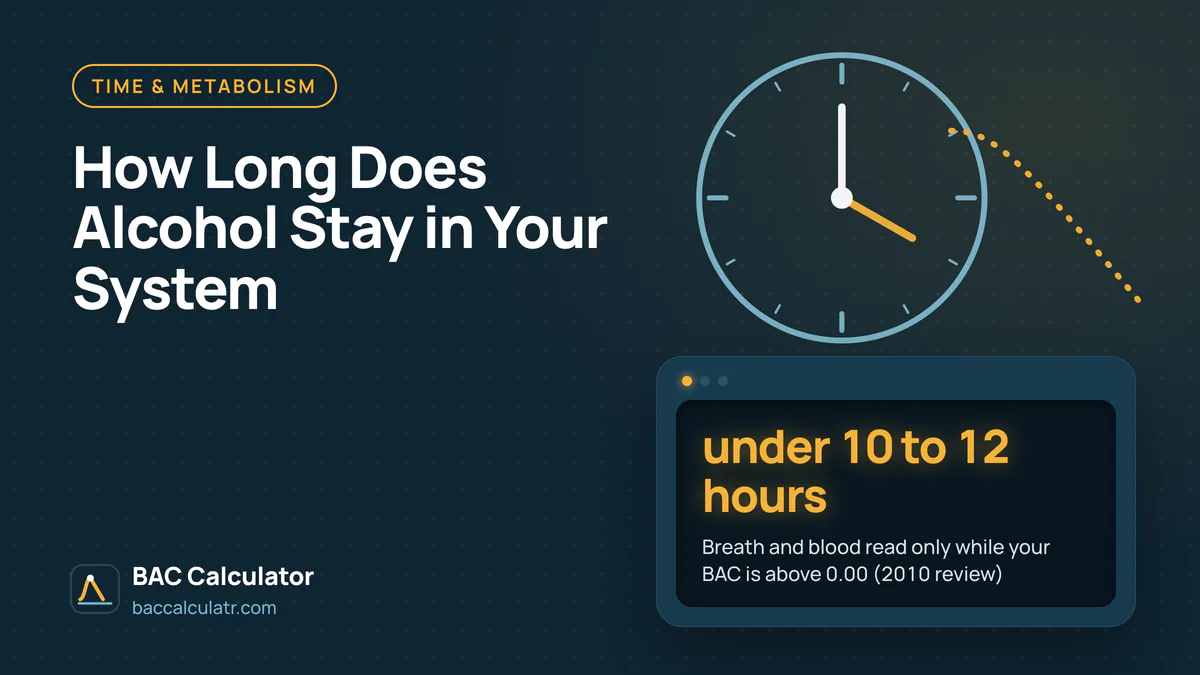
How long does alcohol stay in your system? Hours for breath and blood, days for urine EtG (ethyl glucuronide), and weeks for PEth (phosphatidylethanol) and hair, depending on the test. Breath and blood read only while your BAC is above 0.00, under 10 to 12 hours in a 2010 review. Each window grows with how much you drank and with the lab's cutoff.
Alcohol detection times for each test
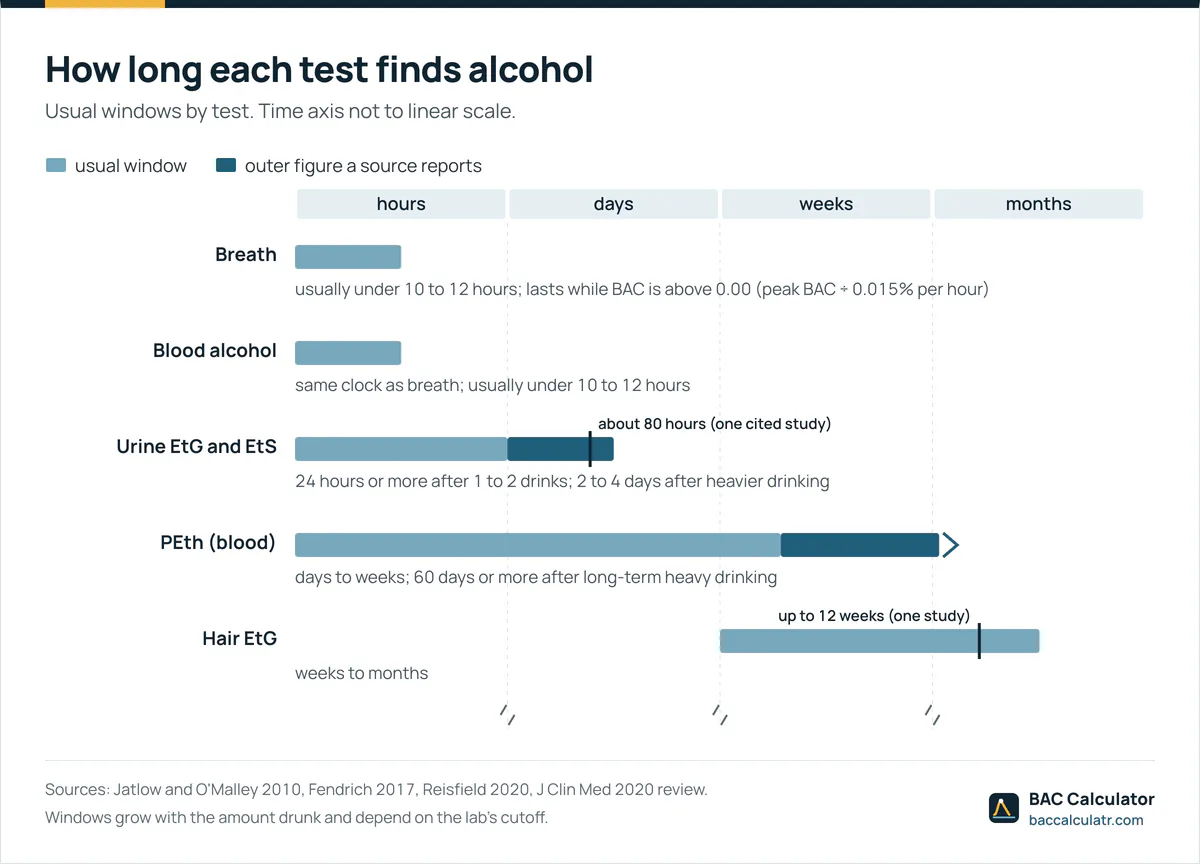
Breath and blood tests read alcohol for hours, while urine, PEth and hair tests find its markers for days to months. Readings from breath and blood come as BAC, where a reading of 0.08% is the same as 80 mg in every 100 mL of blood.
The table lists each test, what it looks for, its usual window and whose figure that is. Each window is a range from its source.
| Test | What it measures | Usual window | Source |
|---|---|---|---|
| Breath (breathalyzer) | Alcohol in the air you breathe out, standing in for BAC right now | Until BAC reaches 0.00 (peak BAC ÷ 0.015% per hour); usually under 10 to 12 hours | Jatlow and O'Malley 2010; Jones 2010 |
| Blood alcohol (ethanol) | Alcohol in the blood right now | Same clock as breath; usually under 10 to 12 hours | Jatlow and O'Malley 2010 |
| Urine EtG and EtS | Ethyl glucuronide and ethyl sulfate, breakdown products of alcohol | 24 hours or more after 1 to 2 drinks; 2 to 4 days after heavier drinking; up to about 80 hours in one cited study | Jatlow and O'Malley 2010; Fendrich 2017 citing Fleming 2009 |
| PEth (blood) | Phosphatidylethanol, a marker of drinking found in blood | Days to weeks; 60 days or more after long-term heavy drinking | J Clin Med 2020 review; Reisfield 2020 |
| Hair EtG | EtG laid down in growing hair | Weeks to months; up to 12 weeks in one study | Fendrich 2017 citing Berger 2014; J Clin Med 2020 review |
How long can a breathalyzer detect alcohol?
A breathalyzer detects alcohol for as long as your BAC stays above 0.00, because breath alcohol tracks blood alcohol at that moment.
How long will alcohol stay on your breath
An estimated peak of 0.10% stays on breath for about 6.7 hours at 0.015% per hour. BAC can keep rising after the last drink, so a breath reading an hour later can be higher. From the peak, the average drinker sheds about 0.015% of BAC an hour (Jones 2010).
You can estimate your own peak BAC from your weight, drinks and hours, then divide it by 0.015% per hour.
A 2010 review by Jatlow and O'Malley says blood and breath alcohol can be measured for "less than 10-12 hours", even after fairly heavy drinking. At 0.015% per hour, 10 to 12 hours matches a peak of about 0.15% to 0.18%. Twelve hours is a typical figure, not a ceiling, because the hours to sober up from each starting BAC keep rising with the peak.
For peaks above 0.15%, BAC levels where alcohol poisoning starts lists the warning signs.
How long does wine stay in your system?
Wine stays in your system about as long as any drink holding the same grams of alcohol. A 12 oz beer at 5% and a 5 oz pour of 12% wine each carry about 14 g, what counts as a standard drink in the US. In one study of 15 fasting men given about 3 drinks' worth, the same dose peaked at 0.062% as wine and 0.050% as beer.
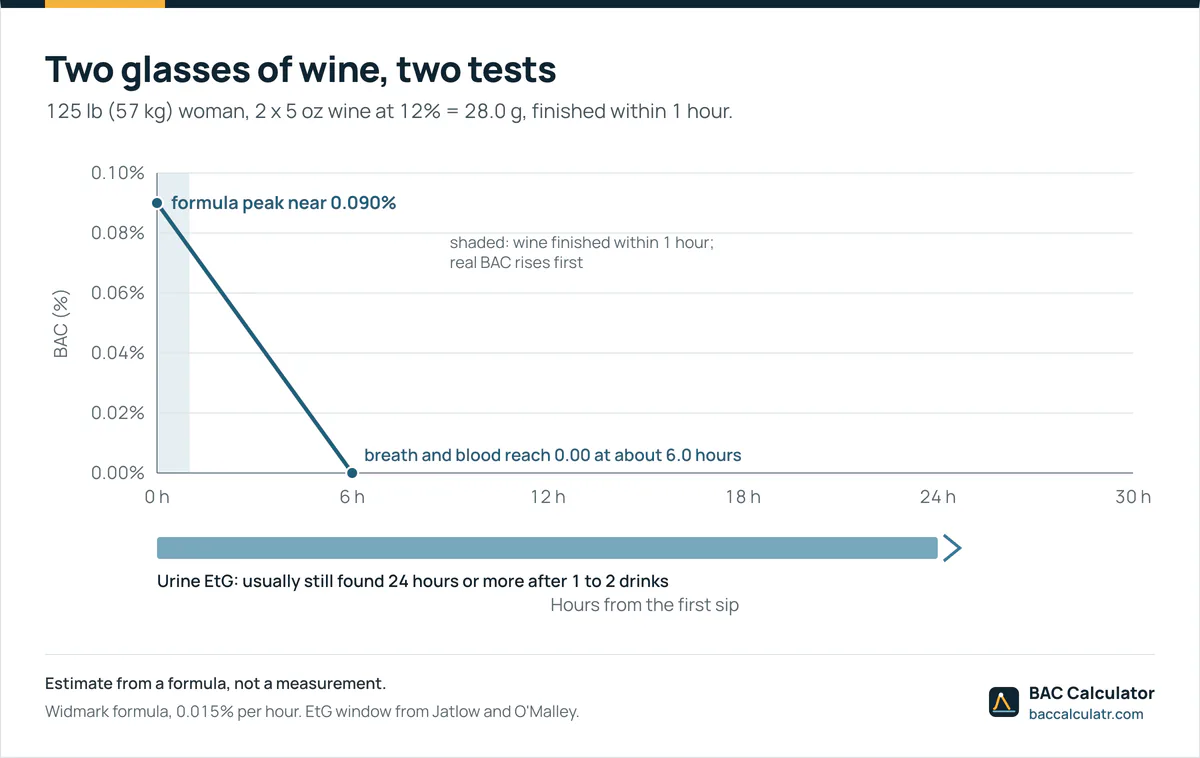
Say a woman weighing 125 lb (57 kg) drinks 2 glasses of wine (2 x 5 oz at 12% = 28.0 g) and finishes within 1 hour. The Widmark formula puts her peak near 0.090% and her time to 0.00 on breath and blood at about 6.0 hours from the first sip. Her real figures could land on either side, because the formula runs on population averages.
The same two glasses usually leave EtG in urine for 24 hours or more, long after breath reads 0.00 (Jatlow and O'Malley). At 0.00, no alcohol is left in the blood. Any reading above that still means alcohol on board, even one under each state's drink driving limit.
EtG test for alcohol in urine
An EtG test for alcohol looks for ethyl glucuronide (EtG), and often ethyl sulfate (EtS), in urine. Both are breakdown products the body makes from alcohol, and they stay in urine far longer than alcohol itself.
The window depends on the dose: Jatlow and O'Malley report EtG for 24 hours or more after one or two drinks, and for two to four days after heavier drinking. Fendrich and colleagues cite a 2009 study by Fleming that gives a urine window of about 80 hours.
Why EtG labs use different cutoffs
A cutoff is the EtG level a lab counts as positive, and studies have used cutoffs from 100 to 500 ng/mL (Jatlow and O'Malley). A lower cutoff picks up drinking for longer, but it also picks up alcohol that never came from a drink.
Nine adults who used hand sanitizer 20 times a day for 5 days had next-morning urine EtG from under 10 to 114 ng/mL. In another study, hourly use up to the elbow produced levels as high as 799 ng/mL. Mouthwash peaks went above 300 ng/mL in some people, but never over 400 ng/mL. Adults with no known alcohol exposure still showed a median of 19 ng/mL.
Jatlow and O'Malley judge that 100 ng/mL may be too low where results carry penalties. They add that 500 ng/mL would screen out most incidental exposure, though higher cutoffs may still be needed.
Alcohol tests that look back weeks
Two tests cover weeks rather than hours or days: PEth in blood and EtG in hair.
PEth blood test
A PEth test measures phosphatidylethanol in blood and can show drinking from days to weeks earlier (J Clin Med 2020 review). The four accredited US labs that run it share a cutoff of 20 ng/mL (Reisfield 2020). The 2022 Consensus of Basel suggests 200 ng/mL as the cutoff for excessive drinking, as reported by Hammarberg (2024). PEth, unlike alcohol, fades by a half-life: 2.4 to 13.6 days. After long-term heavy drinking, it can stay detectable for 60 days or more.
Hair EtG test
Hair EtG shows drinking over weeks to months, up to 12 weeks in one study (Berger 2014, cited by Fendrich). The Society of Hair Testing sets two lab thresholds in its 2019 alcohol marker consensus. A level of 5 pg/mg or less in the 3 to 6 cm of hair nearest the scalp "does not contradict self-reported abstinence". A level of 30 pg/mg or more "strongly suggests chronic excessive alcohol consumption". The consensus defines that as 60 g or more of alcohol a day over several months, about 4.3 US standard drinks a day (60 ÷ 14).
How long does alcohol stay in your system?
Alcohol stays in your system for hours to months, and the amount you drank, the test type and the lab cutoff set where you fall in that span. More grams mean a higher peak, so breath and blood take longer to reach 0.00. For a single drink, how much one beer raises your BAC gives that starting peak. The same drinks give a smaller person a higher peak, and most women a higher peak than men of the same weight. Food eaten before or with drinks slows absorption. The chart of BAC by body weight and drink count shows how far those starting numbers spread.
Feeling less drunk does not shorten the breath window, because a seasoned drinker's breath still carries the same alcohol, as why the same drinks hit people differently explains.
About 90% of a dose is broken down, mostly in the liver, and less than a tenth exits through breath, sweat and urine together. Caffeine in an energy drink left breath alcohol unchanged in one 26-person study, so caffeine is no way to lower BAC.
Does alcohol have a half-life?
Not in the usual sense. Above about 0.02% BAC (20 mg per 100 mL), the body removes a roughly fixed amount of alcohol each hour, which Jones (2010) describes as zero-order kinetics. A half-life model would remove a fixed share instead.
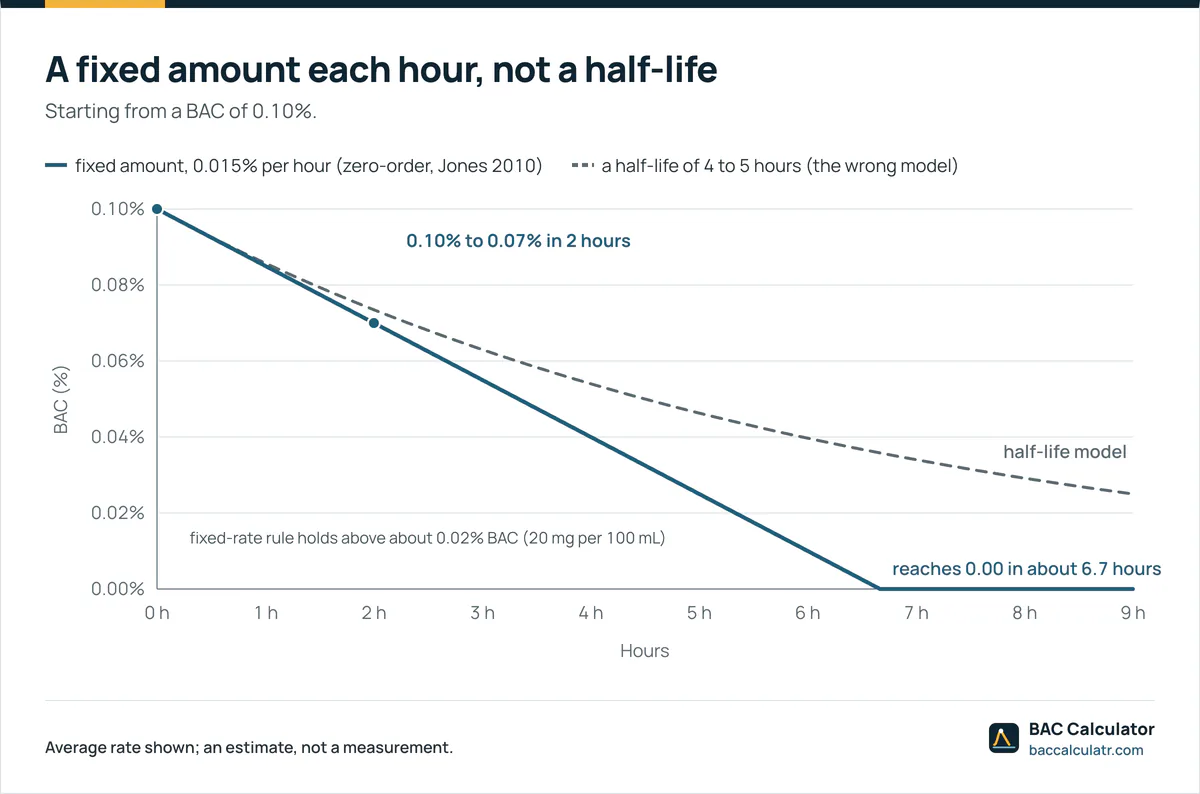
At 0.015% per hour, a BAC of 0.10% drops to 0.07% in 2 hours, and a BAC of 0.20% drops to 0.17% in the same 2 hours. Both lose 0.030%. Under a half-life, the 0.20% level would lose twice as much per hour as the 0.10% level, and low levels would fade slower and slower. A claimed alcohol half-life of 4 to 5 hours uses the wrong model for blood alcohol.
FAQ
Can I have a blood test after drinking alcohol?
Follow the instructions your lab or doctor gives, because the answer depends on the test. Alcohol itself is usually measurable in blood for under 10 to 12 hours, and a PEth blood test looks back days to weeks.
Can a breathalyzer detect alcohol after 24 hours?
Only after an extremely high peak. At 0.015% per hour, a reading 24 hours later means a peak near 0.36%, or about 0.24% at a slow 0.010% per hour. MedlinePlus puts 0.24% in its 0.16% to 0.30% band of more serious intoxication.
How long does a bottle of wine show up?
Urine EtG can show a bottle of wine for two to four days, as Jatlow and O'Malley report after heavier drinking. The National Institute on Alcohol Abuse and Alcoholism (NIAAA) counts a 750 mL bottle of 12% wine as about 5 US standard drinks. On breath, the window is peak BAC divided by 0.015% per hour.
Is a positive EtG test proof of drinking?
Not on its own. Fendrich and colleagues cite 2012 Substance Abuse and Mental Health Services Administration (SAMHSA) guidance that alcohol biomarkers are "not to be used alone" and belong next to self-report. Heavy hand sanitizer use can raise urine EtG, and studies have set cutoffs from 100 to 500 ng/mL, so a result is read in context.
Conclusion
Before guessing a window, find out which sample is being taken and which cutoff the lab uses. The same night of drinking can read negative on one test and positive on another. For breath and blood, the clock starts at your peak. The drink counts that reach 0.08% show how quickly a modest round builds one.