Drink Driving Limit UK
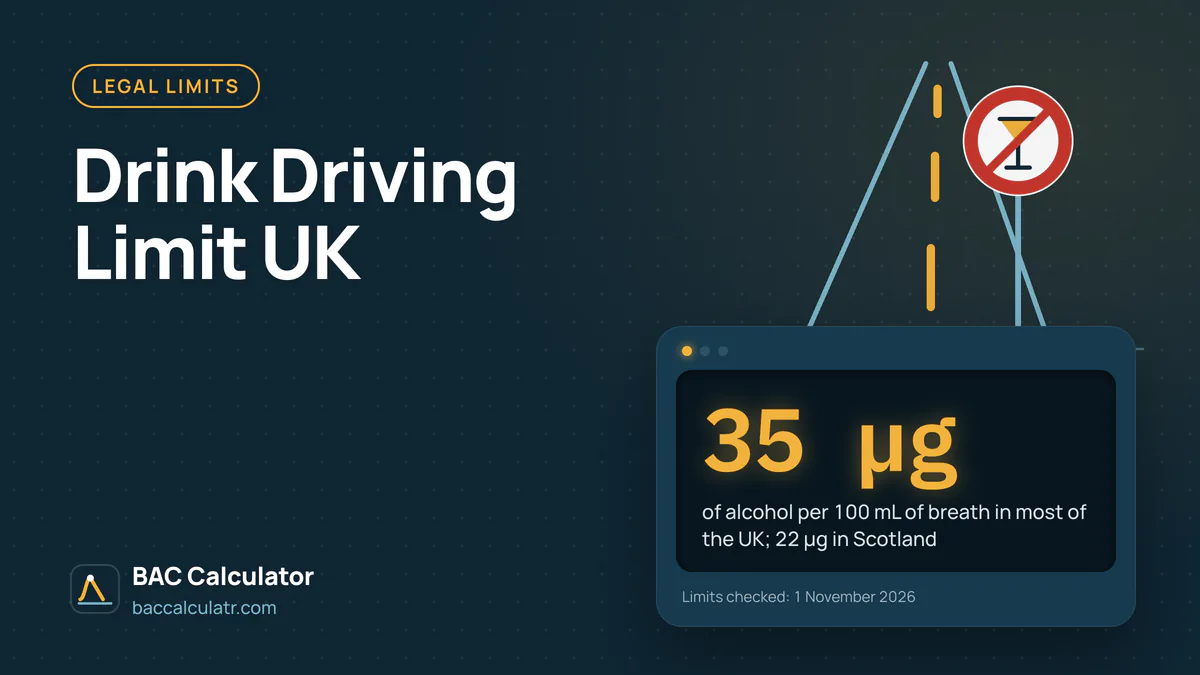
The drink driving limit UK law sets is 35 microgrammes (µg) of alcohol for each 100 mL of breath across England, Wales and Northern Ireland. Blood has its own figure there: 80 mg per 100 mL. Scotland has used a lower limit of 22 µg of breath (50 mg of blood) since 5 December 2014. No number of pints equals either limit. Lower limits for Northern Ireland sit in a 2016 law not yet in force, with no start date.
One limit for each test sample
UK law sets one limit per sample: breath 35 µg, blood 80 mg and urine 107 mg, each per 100 mL, or 22, 50 and 67 in Scotland. For England and Wales the figures sit in the Road Traffic Act 1988, section 11, and Scotland's lower ones come from its own 2014 regulations.
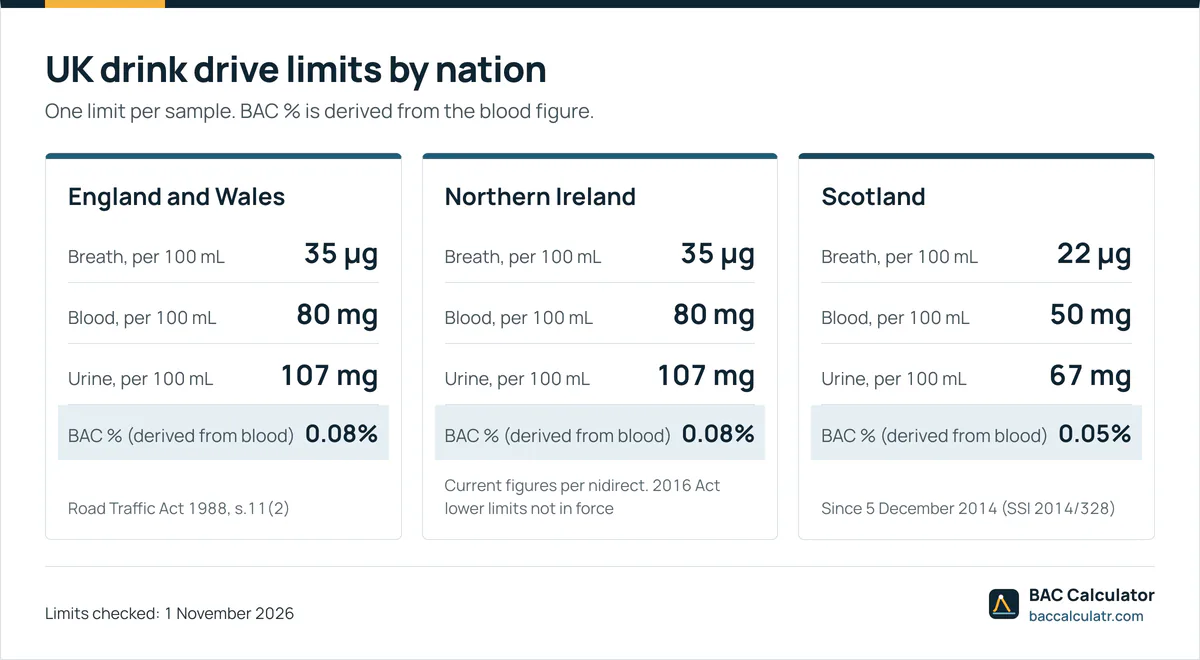
The table shows the limit in force in each nation. Its BAC % column is derived from the blood figure by dividing mg per 100 mL by 1,000.
| Nation | Breath (µg per 100 mL) | Blood (mg per 100 mL) | Urine (mg per 100 mL) | BAC % (derived from blood) | In force since / law |
|---|---|---|---|---|---|
| England and Wales | 35 µg | 80 mg | 107 mg | 0.08% | Road Traffic Act 1988, s.11(2) |
| Northern Ireland | 35 µg | 80 mg | 107 mg | 0.08% | Current figures per nidirect |
| Scotland | 22 µg | 50 mg | 67 mg | 0.05% | Since 5 December 2014 (SSI 2014/328) |
Limits checked: 1 November 2026
In both sets the blood figure works out at about 2,300 times the breath figure (80 mg ÷ 0.035 mg = 2,286; 50 mg ÷ 0.022 mg = 2,273). Urine runs about 1.34 times blood (107 ÷ 80 and 67 ÷ 50). The urine limit counts alcohol itself, unlike urine ethyl glucuronide (EtG) tests and their windows, which look for a breakdown product that lingers well after drinking stops.
The UK limit as a BAC percentage
Written as a percentage, the BAC limit UK law sets is 0.08% in England, Wales and Northern Ireland and 0.05% in Scotland. That is because 80 mg in 100 mL of blood equals 0.08 g in 100 mL. In UK law, 0.02% appears only as Northern Ireland's planned limit for some drivers, in a 2016 Act not yet in force. The 0.08% figure matches the BAC limit in most US states, and Scotland's 0.05% matches Utah's.
The Widmark formula in mg per 100 mL answers in the same unit as the blood limit. A BAC calculator turns your weight, drinks and hours into the % form. That figure is an estimate, not a breath, blood or urine test, and only those tests count under the law.
Why is the breath limit in microgrammes?
Breath holds far less alcohol per mL than blood on the legal figures, so a smaller unit fits it. UK law writes a separate limit for each sample, and the breath one is set in microgrammes per 100 mL of breath. A percentage converts only the blood figure; it is not the test the law applies.
Drink driving limit Scotland vs England
The drink drive limit Scotland has used since 5 December 2014 is lower than England's: 22 µg against 35 µg of breath, and 50 mg against 80 mg of blood. That is about 37% lower in each sample (derived: 13 ÷ 35 = 37.1% for breath, 30 ÷ 80 = 37.5% for blood). So the drink driving limit UK drivers must meet depends on where they drive.
Scottish Statutory Instrument 2014/328, made on 20 November 2014, cut Scotland's blood limit from 80 mg to 50 mg. Scotland could do this because the Scotland Act 2012, in the Scottish Government's words, "devolved the power to set the blood alcohol limit" to the Scottish Parliament.
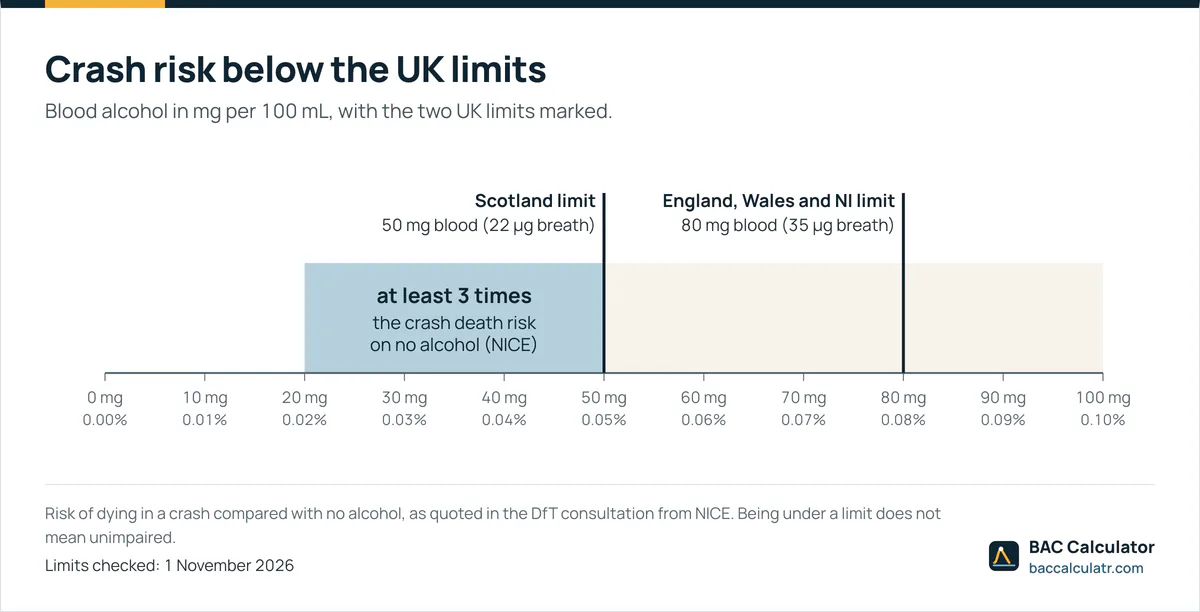
The Department for Transport (DfT) consultation quotes figures from the National Institute for Health and Care Excellence (NICE). They show impairment below the legal limit: at 20 to 50 mg, crash death risk is at least 3 times that on no alcohol. The limit that applies is the one where you drive.
Drink driving limit UK in pints
No UK law turns the limit into pints. Both gov.uk and nidirect say it is "impossible to say exactly how many drinks" the limit equals. For Scotland, mygov.scot says the limit "cannot be changed into drinks or units".
Even the pint is not a fixed amount of alcohol. The National Health Service (NHS) puts a 568 mL pint of lower-strength lager at just over 2 units and a pint of strong 5.2% lager at 2.95. Wine at 12% served as a 175 mL glass comes to 2.10 units (175 x 12 ÷ 1,000), and gov.uk gives no glass count for the limit. A US chart's drink counts do not carry over either, since standard drink sizes by country set the UK unit well below a 14 g US drink.
Am I over the limit after 2 pints?
You could be, and the number of drinks that reaches 0.08% BAC differs for every drinker. For Scotland, mygov.scot warns that one drink "can put you over the limit". The gov.uk page lists what changes the result: weight, age, sex, metabolism, the type and amount of alcohol, recent food and stress. One beer raises BAC by a different amount at each body weight. Pints from the night before count too. The nidirect page says you can be over the limit many hours after your last drink, even after sleeping. The time BAC takes to reach zero runs from the peak. The same pint also lands on a different row of a BAC chart by body weight for each drinker.
Has Northern Ireland lowered its drink drive limit?
Not yet. The Road Traffic (Amendment) Act (Northern Ireland) 2016, section 2, writes lower limits into law, but legislation.gov.uk marks that section "prospective", meaning not in force. The nidirect page still gives 35 µg, 80 mg and 107 mg.
For most drivers the Act sets 22 µg of breath, 50 mg of blood and 67 mg of urine. For specified persons it sets 9 µg, 20 mg and 27 mg (0.02% BAC, derived).
Specified persons are provisional licence holders, drivers with a full licence for 2 years or less, taxi drivers working for hire or reward, and drivers of certain vehicle categories. It also covers anyone falsely claiming one of those licences, and anyone driving without a licence for that class of vehicle. Other parts of the 2016 Act came into force in 2016, 2020 and 2021, but section 2 was not among them. DfT's 2026 consultation says Northern Ireland plans lower limits "in the near future" but gives no date. Since 2016, police in Northern Ireland can also run random breath tests at checkpoints when a police inspector authorises them.
Is the drink drive limit changing in 2026?
Not in England and Wales so far: legislation.gov.uk shows section 11, with its 35 µg limit, up to date to 1 November 2026. DfT's 2026 strategy says the 80 mg blood limit there has not changed since it was introduced in 1969.
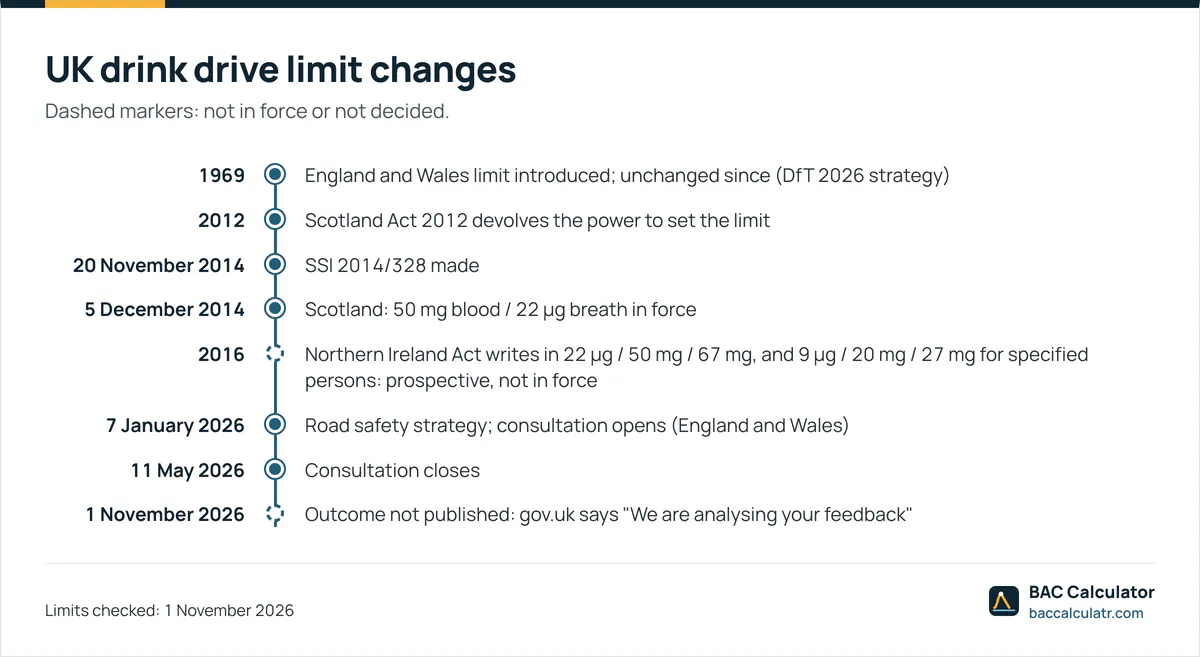
The road safety strategy of 7 January 2026 promised a consultation on a lower limit for England and Wales, with a still lower one for novice drivers. That consultation ran from 7 January to 11 May 2026, after its closing date was extended on 16 February. On the drink drive limit consultation page, gov.uk now says "We are analysing your feedback".
The consultation asks what limit is right but proposes no number for England and Wales. The 22 µg and 50 mg figures in the consultation are Northern Ireland's planned limits, so no cut to 22 µg has been decided for England and Wales. DfT's strategy calls the current limit "the highest in Europe".
Do new or professional drivers get a lower limit?
Not in Great Britain on 1 November 2026. The Road Traffic Act 1988 and Scotland's 2014 regulations each set one limit for every driver, whatever their experience or job. A 0.02% limit for professional drivers exists only in Northern Ireland's 2016 law, which is not yet in force. England and Wales consulted on a novice limit, with no outcome yet.
How many die in UK drink drive crashes?
DfT's central estimate for Great Britain in 2023 is 260 deaths in drink drive collisions, within a range of 230 to 290. That was 16% of all road deaths in Great Britain that year, or 1 in 6 in DfT's strategy.
FAQ
Is one glass of wine over Scotland's limit?
It can be, and Scottish law gives no glass count to rely on. A 175 mL pour of wine at 12% holds 2.10 units, against a limit set about 37% below England's. What that glass does to your reading depends on your body and the hours since, and only a breath, blood or urine test measures it.
Is Scotland's drink drive limit zero tolerance?
No. Scotland's limit is 22 µg of breath and 50 mg of blood, not zero, and it applies to new and experienced drivers alike. No UK nation sets a zero limit; the lowest figure in UK law is Northern Ireland's planned 9 µg of breath for specified persons, not yet in force.
Will Scotland's limit change if England's does?
Not automatically. Scotland sets its own limit under powers the Scotland Act 2012 devolved, so the lower limit DfT consulted on in 2026 is for England and Wales only. Scotland still used 22 µg of breath, 50 mg of blood and 67 mg of urine when the limits were checked on 1 November 2026.
How does the UK limit compare with Australia's?
England, Wales and Northern Ireland sit higher, because 80 mg of blood works out at 0.08% BAC against Australia's 0.05 on a full licence. Scotland's 50 mg equals 0.05%, the same line. New drivers are treated differently there, and Australia's limits by licence type show who there must stay at zero.
Conclusion
A Scottish breath test and an English blood test are read against different numbers, so both the nation and the sample decide which limit applies. Being under that line is not the same as unimpaired: the NICE figures DfT quotes put crash death risk at least 3 times higher from 20 mg. For what 0.05% and 0.08% do to a driver, see how each BAC level affects you.