How Many Drinks to Get Drunk
Within 2 hours, 4 to 5 US standard drinks put a 150 lb (68 kg) man's estimate at 0.09% to 0.12%. Lighter or heavier, how many drinks to get drunk shifts with body weight, sex and pace. For a 150 lb woman, 3 to 4 drinks reach 0.08% to 0.12%, where balance, speech and reactions suffer. Tolerance mostly changes how drunk someone looks, not the BAC. Enter your own weight, drinks and hours in the BAC calculator.
Two hours of drinking at 120 to 210 lb
Smaller bodies and women hold less body water, so equal drinks read higher on them: a 120 lb woman's estimate runs more than twice a 210 lb man's. Within 2 hours, 3 drinks bring a 120 lb man near 0.08%, while a 210 lb man takes about 6 to hit 0.10%. Women reach each level about half a drink to one drink earlier.
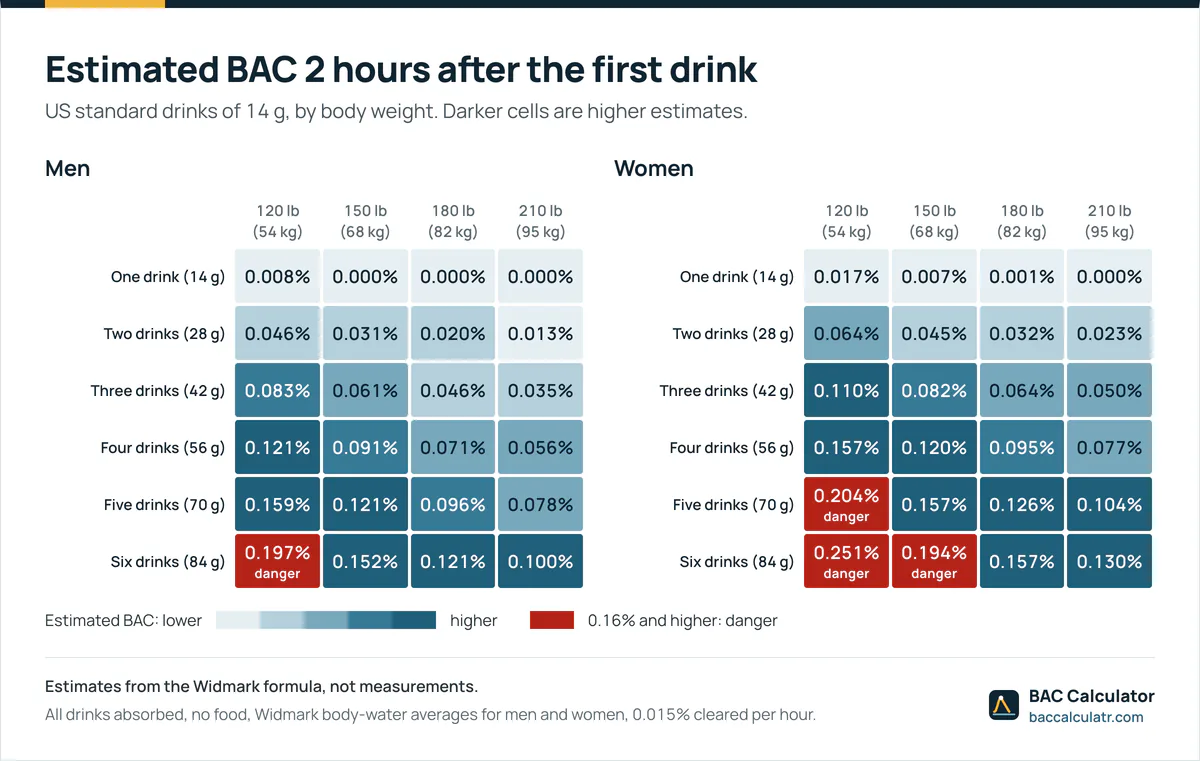
The tables show estimated BAC 2 hours after the first of 1 to 6 US standard drinks. They use the Widmark averages for each sex and the 0.015% hourly drop, with every drink fully absorbed and no food in the stomach.
| Men, drinks in 2 hours | 120 lb (54 kg) | 150 lb (68 kg) | 180 lb (82 kg) | 210 lb (95 kg) |
|---|---|---|---|---|
| 14 g, one drink | 0.008% | 0.000% | 0.000% | 0.000% |
| 28 g, two drinks | 0.046% | 0.031% | 0.020% | 0.013% |
| 42 g, three drinks | 0.083% | 0.061% | 0.046% | 0.035% |
| 56 g, four drinks | 0.121% | 0.091% | 0.071% | 0.056% |
| 70 g, five drinks | 0.159% | 0.121% | 0.096% | 0.078% |
| 84 g, six drinks | 0.197% danger | 0.152% | 0.121% | 0.100% |
| Women, drinks in 2 hours | 120 lb (54 kg) | 150 lb (68 kg) | 180 lb (82 kg) | 210 lb (95 kg) |
|---|---|---|---|---|
| 14 g, one drink | 0.017% | 0.007% | 0.001% | 0.000% |
| 28 g, two drinks | 0.064% | 0.045% | 0.032% | 0.023% |
| 42 g, three drinks | 0.110% | 0.082% | 0.064% | 0.050% |
| 56 g, four drinks | 0.157% | 0.120% | 0.095% | 0.077% |
| 70 g, five drinks | 0.204% danger | 0.157% | 0.126% | 0.104% |
| 84 g, six drinks | 0.251% danger | 0.194% danger | 0.157% | 0.130% |
Each cell comes from the Widmark formula, which treats every drink as already absorbed, so a real BAC can sit higher or lower. The BAC charts at 1 and 3 hours for 100 to 260 lb apply the same math to more weights.
Cells marked danger are at 0.16% or higher. Get emergency help (911 in the US) for anyone who is confused, cannot stay awake, has a seizure or breathes slowly. The alcohol poisoning signs and first aid list the rest. Buzzed or tipsy, the relaxed, altered mood that the National Highway Traffic Safety Administration (NHTSA) describes, comes before drunk, as what each BAC level means shows.
Why do I get drunk faster than my friends?
Size, sex and pace explain most of the gap. In the women's table, four drinks put a 150 lb woman at 0.120%, while the same four leave a 180 lb man at 0.071%. A friend who seems unaffected may only look steadier: in the 2012 study below, tolerance dulled motor effects but not BAC or self-control.
Does the type of drink matter?
By alcohol content, no. Counted in US standard drinks, beer, wine and spirits all deliver the same 14 g of alcohol per drink. What differs is pace and mixer.
Can beer get you drunk?
Yes, though one regular can rarely does it. Beer carries the same 14 g per standard drink, just in more liquid. A single 12 oz beer sits under 0.02% two hours on for most weights in the tables. How much beer to get drunk on depends more on the can than the count. Strong craft beers and tall cans can hold two or more of the 14 g standard drinks.
Can wine get you drunk?
Yes. Asking how many glasses of wine to get drunk assumes one glass size, and glasses vary. A 9 oz glass of 13% wine holds 27.3 g, or 1.95 standard drinks. That glass adds nearly twice the BAC of one standard beer, glass or shot. In the surveys below, wine drinkers tended to report fewer drinks to feel drunk.
Do shots get you drunk faster?
A 1.5 oz shot at 40% ABV is one standard drink, so the shot count reads straight off the tables above. Shots often hit faster, mostly because a shot goes down in seconds, and NHTSA says alcohol taken quickly gives a higher BAC. A crossover study of 15 fasting men gave each the same dose, about 41 g, within 20 minutes as beer, wine and vodka with tonic. Average peaks were 0.050%, 0.062% and 0.077%. Vodka with tonic peaked at about 36 minutes, against about 54 for wine and 62 for beer, and only the vodka timing differed significantly.
Do mixed drinks get you drunk faster?
In small lab studies, they did. Diluted, fizzy or diet-mixed vodka showed up in the breath faster or higher, so the same count can read higher than expected. Roberts and Robinson (2007) gave 21 fasting adults vodka three ways. Diluted to about 19%, it was absorbed faster than neat in 20 of them. A carbonated mixer sped absorption in 14 of 21.
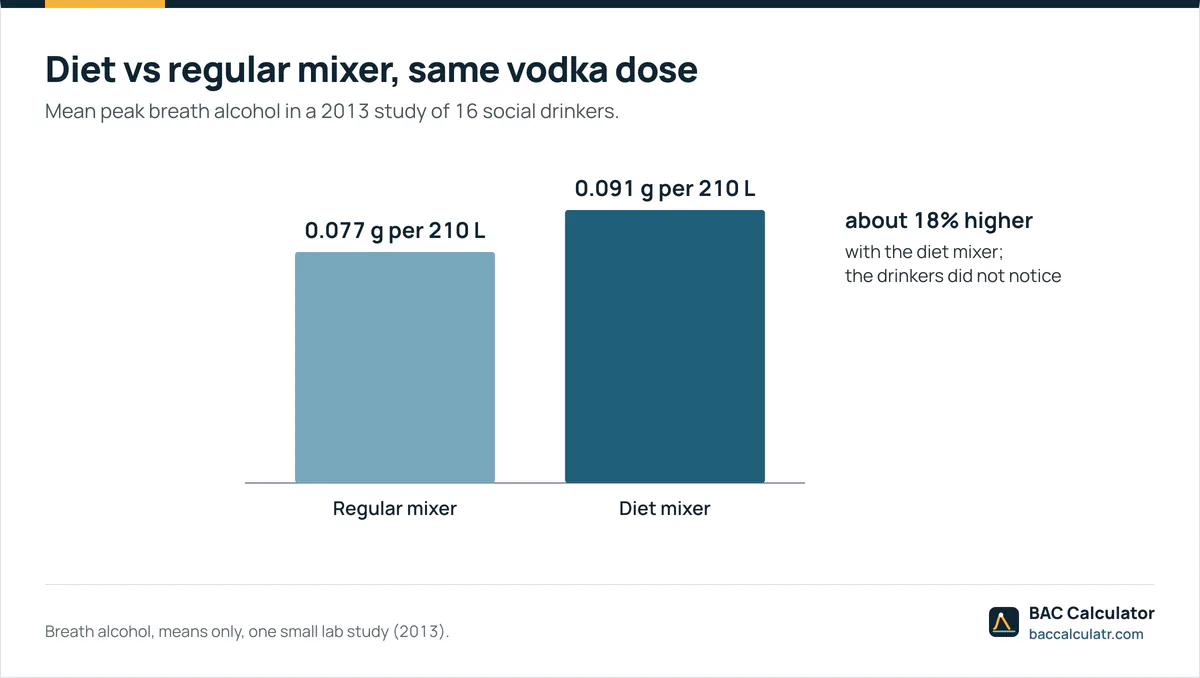
Diet mixers showed a bigger gap. A 2013 study of 16 social drinkers found a mean peak breath alcohol of 0.091 g per 210 L with diet mixer versus 0.077 with regular, about 18% higher. The drinkers did not notice. A follow-up with 20 adults found 22% and 25% higher breath alcohol at 40 minutes, at two doses.
Tolerance changes the feeling more than the BAC
Tolerance is a weaker response to the same dose after repeated drinking, and in the study below it did not lower the BAC. A 2012 lab study of 52 drinkers gave everyone the same dose per kilogram. Heavier recent drinking went with less motor impairment but had no link to impaired inhibitory control, and BAC showed no relation to drinking habits. Clearance can differ: people in alcohol detox clear 0.025% to 0.035% per hour. NHTSA notes that vomiting near 0.15% may not happen once tolerance builds, which hides a warning sign. The National Institute on Alcohol Abuse and Alcoholism (NIAAA) lists tolerance among the factors that can tip drinking into an overdose.
Why am I not getting drunk?
Usually because BAC is still climbing, the drinks were spread out or taken with food, the body is larger, or tolerance hides the signs. A quick round judged at once feels weaker than it will, because the gut is still passing alcohol into the blood after the glass is empty.
A slower pace gives a lower peak, and on the way down people tend to feel less drunk than their falling BAC shows. NHTSA adds that people often miss their own impairment because of the alcohol itself. The fall runs at about 0.015% an hour, so the wait from any peak to 0.00 is counted in hours, not minutes.
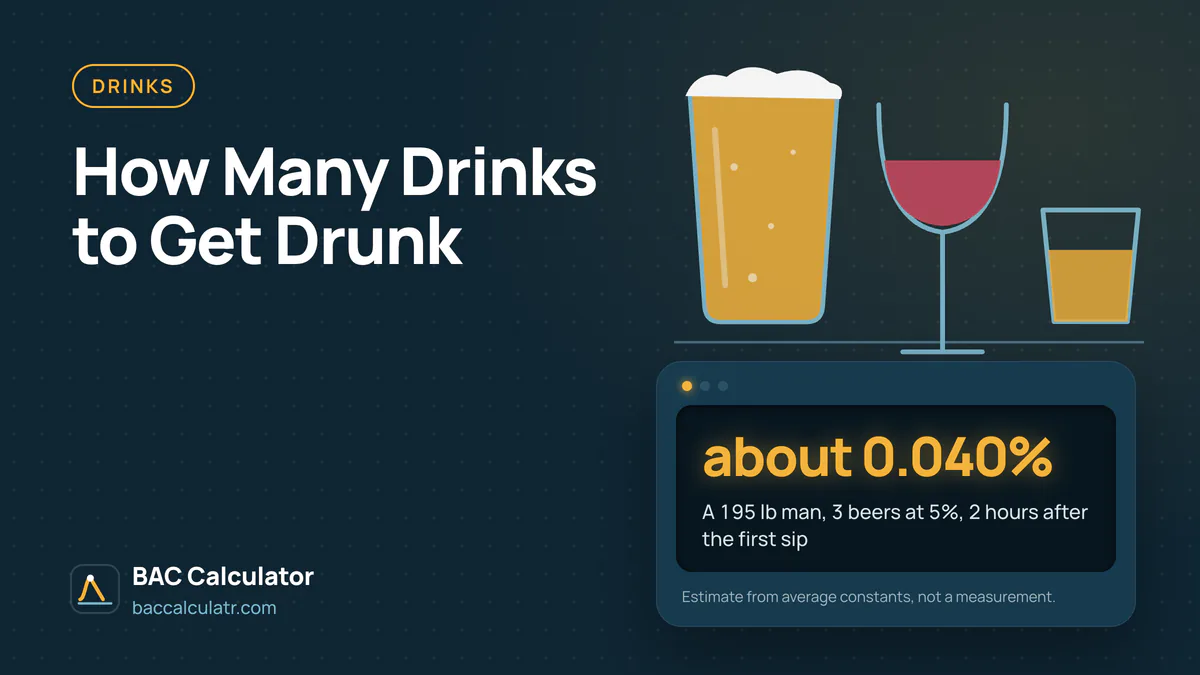
Three beers in 2 hours at 195 lb
A 195 lb (88 kg) man drinks three 12 oz beers at 5% and checks 2 hours after the first sip. His drinks hold 42 g of alcohol. At r 0.68 that comes to 0.070% fully absorbed, and two hours of clearing at 0.015% per hour leaves about 0.040%.
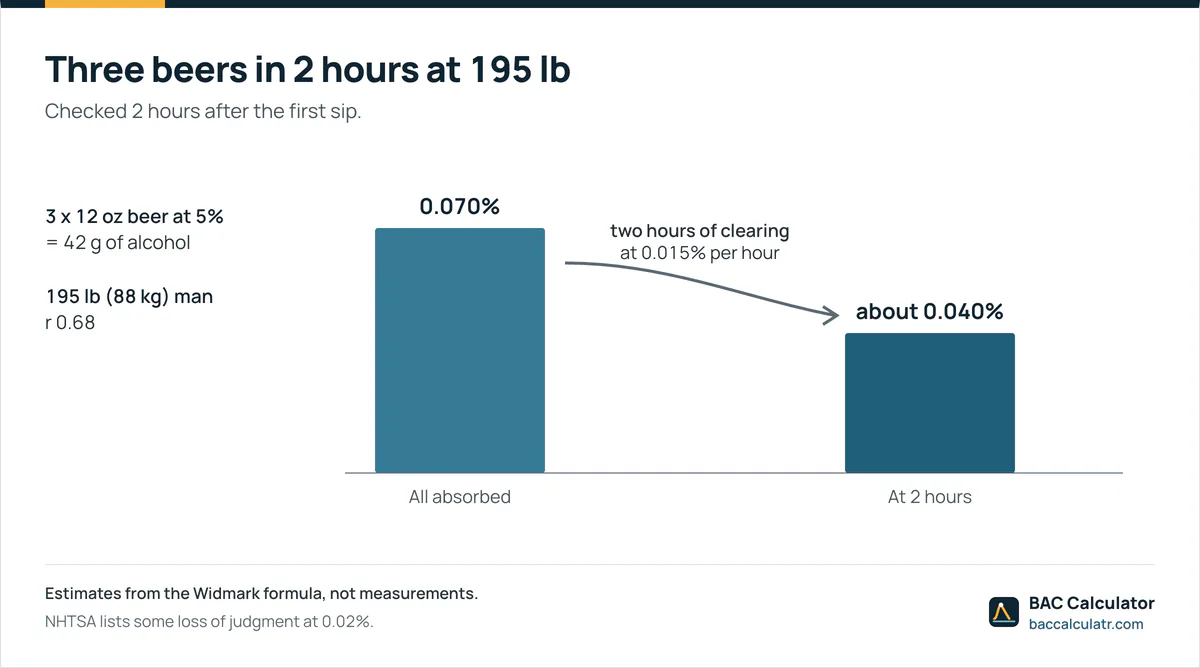
Even if he feels almost nothing, NHTSA lists some loss of judgment at 0.02%, so how many drinks reach the 0.08% limit is not where effects start.
How many drinks to get drunk in US surveys
In three US surveys, the drinks people said it took to feel drunk fell over time and were lower for women. Kerr, Greenfield and Midanik (2006) traced the drop across 1979, 1995 and 2000, with wide variation in each survey. The authors' 2004 American Public Health Association (APHA) abstract gave the averages: women 5.7, then 4.6, then 4.1 drinks; men 9.8, then 7.5, then 6.7. No drink size was defined and no BAC was measured. These are reports of a feeling, not counts to aim for.
Drinking games and fast drinking
Drinking games are linked to higher breath alcohol at parties. A 2008 field study by Clapp and colleagues breath-tested 1,304 people at 66 parties near a US university. Those who played drinking games had breath alcohol about 0.013 g per 210 L higher on average, an association rather than proof of cause. NIAAA warns that too much alcohol too quickly is dangerous because BAC climbs so fast.
FAQ
How soon after drinking do you feel drunk?
You feel it build while BAC climbs, and on an empty stomach that climb usually runs for about an hour after drinking. Food slows absorption, so the same round rises more slowly after a meal, and the tables above assume no food.
Can two beers get you drunk?
Two regular beers within 2 hours put the estimate between 0.013% and 0.064%, lowest for a 210 lb man and highest for a 120 lb woman. NHTSA lists some loss of judgment from 0.02%, a level seven of those eight readings reach.
How many standard drinks get you drunk in Australia?
More by count, though not more alcohol. These tables use the 14 g US drink, while an Australian standard drink holds 10 g and a UK unit 8 g. The 4 to 5 US drinks that take a 150 lb man to 0.09% to 0.12% in 2 hours equal 5.6 to 7 Australian standard drinks.
How much wine gets you drunk?
One 750 mL bottle at 12% holds about 5 US standard drinks. Five drinks in 2 hours read 0.078% to 0.159% on the men's table. Women of the same weights land at 0.104% to 0.204%, and that top cell sits in the danger band.
Conclusion
How drunk you feel is a poor gauge of the alcohol in your blood, so the drink count and the hours since the first one tell you more. A diet mixer or an oversized glass can put a real reading above its cell. Breath and urine tests can still pick up alcohol once the feeling has faded, for hours on breath and longer in urine according to each test's detection window.