Drink Driving Limit Australia
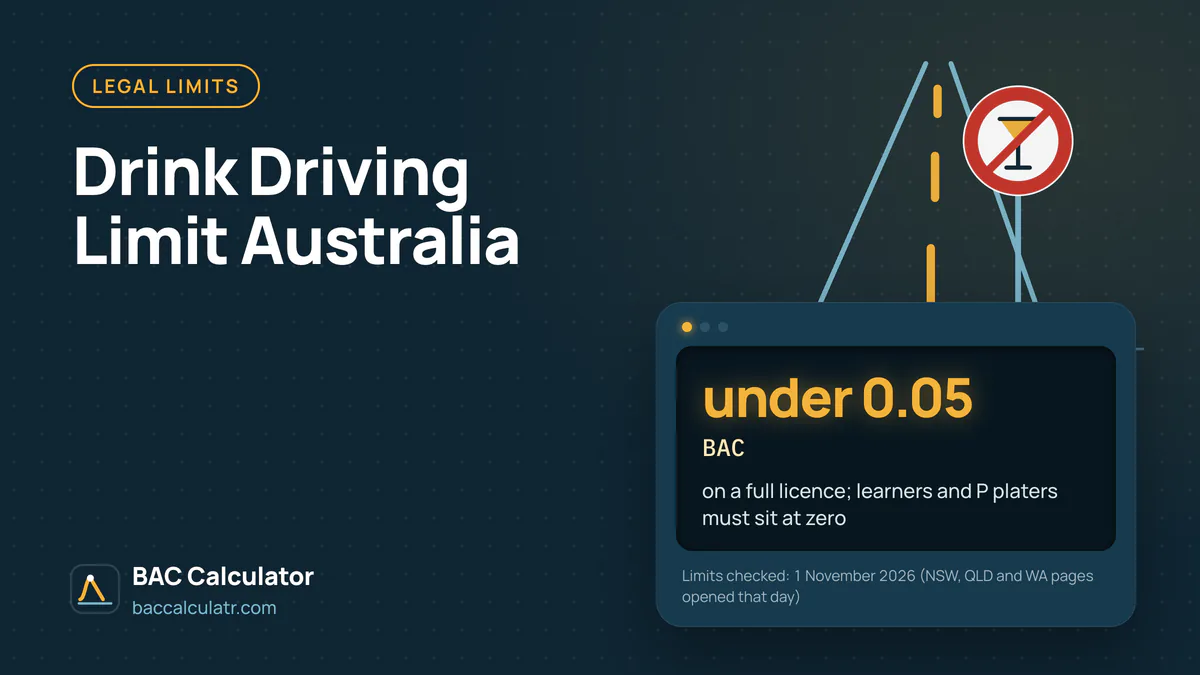
The drink driving limit Australia sets is a BAC of 0.05 on a full licence in every state and territory, and zero for learner and P plate drivers. Many bus, taxi and heavy vehicle drivers must also be at zero. New South Wales (NSW) adds an under 0.02 limit for some heavy, dangerous goods and public vehicles.
The 0.05 line and who sits at zero
The legal drink driving limit Australia applies to full licence holders is under 0.05, while learners and P platers must sit at zero. The Australian Government health page on alcohol laws states it plainly: "your BAC must be zero". A BAC of 0.05 counts 0.05 g of alcohol in 100 mL of blood. A BAC calculator uses that same unit for an estimate from your weight, drinks and hours.
Drivers from abroad know other lines: the BAC limit in each US state is 0.08%, and UK drink driving limits by nation are set in breath as well as blood.
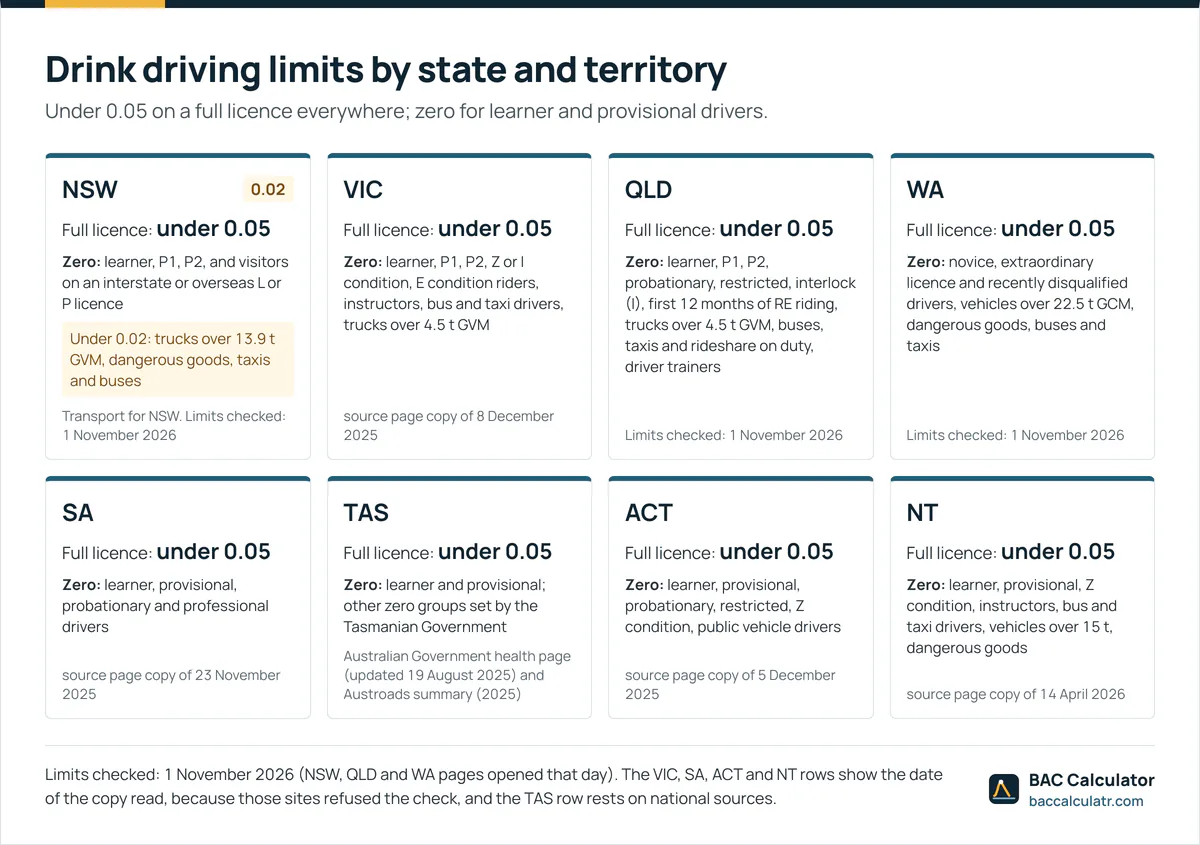
The table gives each state's limits, zero groups and source date.
| State or territory | Full licence limit | Must be at 0.00 | 0.02 category | Source and date |
|---|---|---|---|---|
| New South Wales (NSW) | under 0.05 | learner, P1, P2, and visitors on an interstate or overseas L or P licence | under 0.02 for trucks over 13.9 t GVM, dangerous goods, taxis and buses | Transport for NSW. Limits checked: 1 November 2026 |
| Victoria (VIC) | under 0.05, supervising drivers included | learner, P1, P2, Z or I condition, E condition riders, instructors, bus and taxi drivers, trucks over 4.5 t GVM | none | Department of Transport and Planning, page dated 8 December 2025 |
| Queensland (QLD) | under 0.05 (open licence) | learner, P1, P2, probationary, restricted, interlock (I), first 12 months of RE riding, driver trainers, trucks over 4.5 t GVM, buses, taxis and rideshare on duty | none | Queensland Government (page updated 17 December 2024). Limits checked: 1 November 2026 |
| Western Australia (WA) | under 0.05 | novice, extraordinary licence and recently disqualified drivers, buses and taxis, dangerous goods, vehicles over 22.5 t GCM | none | Road Safety Commission (page updated 4 September 2026). Limits checked: 1 November 2026 |
| South Australia (SA) | under 0.05, supervising drivers included | learner, provisional, probationary and professional drivers | none | My Licence SA, page dated 23 November 2025 |
| Tasmania (TAS) | under 0.05 | learner and provisional; other zero groups set by the Tasmanian Government | not set out in national sources | Australian Government health page (updated 19 August 2025) and Austroads summary (2025) |
| Australian Capital Territory (ACT) | under 0.05 | learner, provisional, probationary, restricted, Z condition, public vehicle drivers | none | Access Canberra, page dated 5 December 2025 |
| Northern Territory (NT) | under 0.05, fully licensed visitors included | learner, provisional, Z condition, instructors, bus and taxi drivers, vehicles over 15 t, dangerous goods | none | NT Government, page dated 14 April 2026 |
Limits checked: 1 November 2026 (NSW, QLD and WA pages opened that day). VIC, SA, ACT and NT rows carry the date of the state page they follow, and the TAS row follows national sources.
The truck weight where zero starts varies: over 4.5 t in Victoria and Queensland, 15 t in the NT and 22.5 t GCM (gross combination mass) in WA. NSW instead applies under 0.02 above 13.9 t GVM (gross vehicle mass).
National summaries do not always match the states. Austroads' 2025 summary puts Victoria's heavy vehicle zero at over 15 t GVM, while Victoria's own page says over 4.5 t. For Queensland, Austroads names B-doubles and road trains, but the state page covers any truck over 4.5 t. Each row above follows the state's own page.
BAC limit NSW and the 0.02 limit
The BAC limit NSW sets has three levels: "zero, under 0.02 and under 0.05", in the words of Transport for NSW. Learner, P1 and P2 drivers sit at zero, as do visitors on an overseas or interstate learner or provisional licence. Drivers of vehicles over 13.9 t GVM, dangerous goods loads and public vehicles such as taxis and buses must stay under 0.02. Every other licence falls under 0.05. Transport for NSW also says "Every police car is a mobile RBT", so a random breath test can happen on any drive.
Drink driving limit QLD by licence type
The drink driving limit QLD sets for an open licence is 0.05, and the Queensland Government counts a reading "equal to or more than 0.05" as over. Zero covers every learner, P1, P2, probationary and restricted licence holder, whatever their age. It also covers interlock (I) drivers and riders in their first 12 months on an RE motorcycle licence. On duty, drivers of trucks over 4.5 t GVM, buses, taxis and rideshare cars, and driver trainers, must be at zero too.
P plate, truck and taxi zero limits
Every learner and provisional driver in Australia must have a zero BAC, and so must many people who drive for work. The zero groups fall into three kinds:
- New drivers. P platers have a BAC limit of zero in every state, as learners do. QLD, SA and the ACT add probationary licences.
- Licence conditions. Victoria holds Z and I condition drivers to zero, Queensland its interlock drivers, and the ACT and NT their Z condition drivers. WA adds recently disqualified drivers.
- Work driving. Bus and taxi drivers are at zero in six of the eight rows and heavy vehicle drivers in five, while NSW holds them to under 0.02. Victoria, Queensland and the NT add instructors, and Queensland adds rideshare drivers on duty.
Victoria also makes it illegal to drink alcohol while driving, or while supervising a learner, even when your BAC stays below your limit. Supervising drivers in Victoria and South Australia must themselves be under 0.05.
The 2 standard drinks in the first hour guide
The guide caps men at 2 standard drinks over the first hour and 1 an hour after that, and women at 1 an hour throughout. Western Australia's Road Safety Commission and the Northern Territory (NT) Government both publish it. The WA Road Safety Commission calls it "a guide" and warns you could be over without knowing. The NT opens its version with "Everyone is different but as a guide", after saying it is best not to drink before driving at all.
The guide never applies on a zero limit. It counts Australian drinks of 10 g, so a US or UK count does not carry over, as standard drink sizes in Australia and other countries show.
A reading under 0.05 is not the same as no impairment: Victoria's government page puts crash risk at 0.05 at about double the risk at zero. After heavy drinking, Victoria also says you are likely to still be over the limit the next day. The time BAC takes to fall to 0.00 is counted from the peak you reached. Coffee does not change that, as the sobering-up myths set out.
A 55 kg woman following the men's guide
A 55 kg (121 lb) woman has 2 Australian standard drinks in the first hour, the men's version: 20 g of alcohol in all. The Widmark formula, with a body water factor of 0.55 and 0.015% cleared per hour, puts her at an estimated 0.051% after 1 hour.
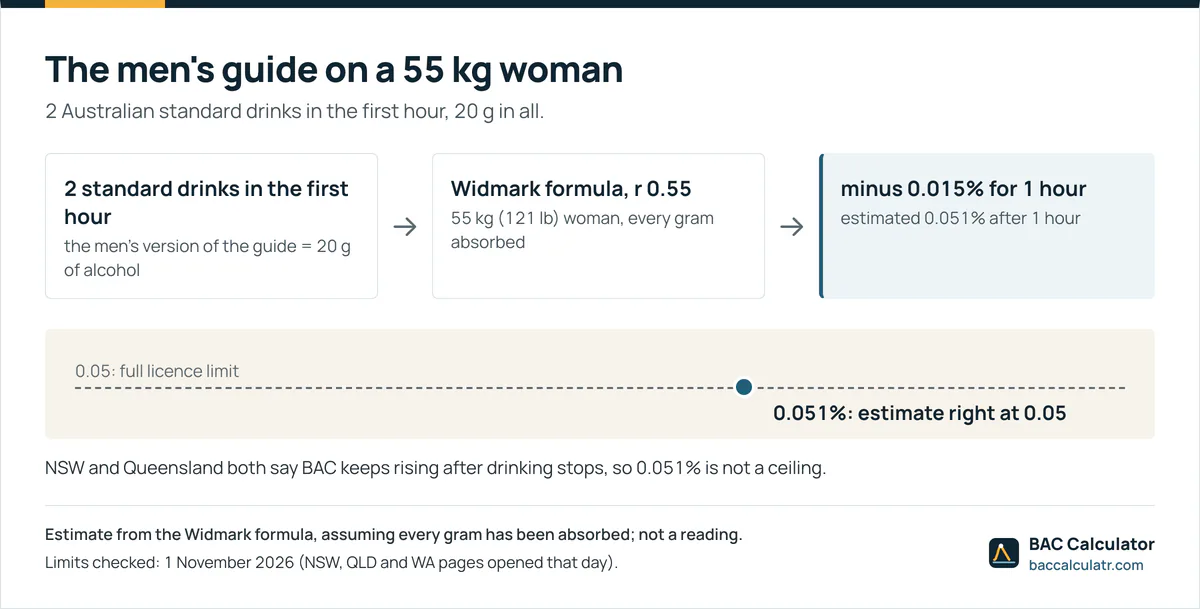
That estimate sits right at 0.05 and assumes every gram has been absorbed. NSW and Queensland both say BAC keeps rising after drinking stops, so 0.051% is not a ceiling, as when BAC peaks after the last drink explains.
Women reach a higher estimate from the same drinks on the BAC charts for men and women by weight. SA Health puts the rise from one standard drink at about 0.01 to 0.03%, and how much one drink raises BAC by weight breaks that range down.
How many standard drinks reach 0.05 in Australia
Counted in Australian 10 g drinks, a woman of 50 to 100 kg reaches an estimated 0.05 within one hour at 1.8 to 3.6. A man gets there at 2.2 to 4.4. These are crossing points for the drink driving limit Australia sets on a full licence, not a number to aim for, and they mean nothing on a zero limit.
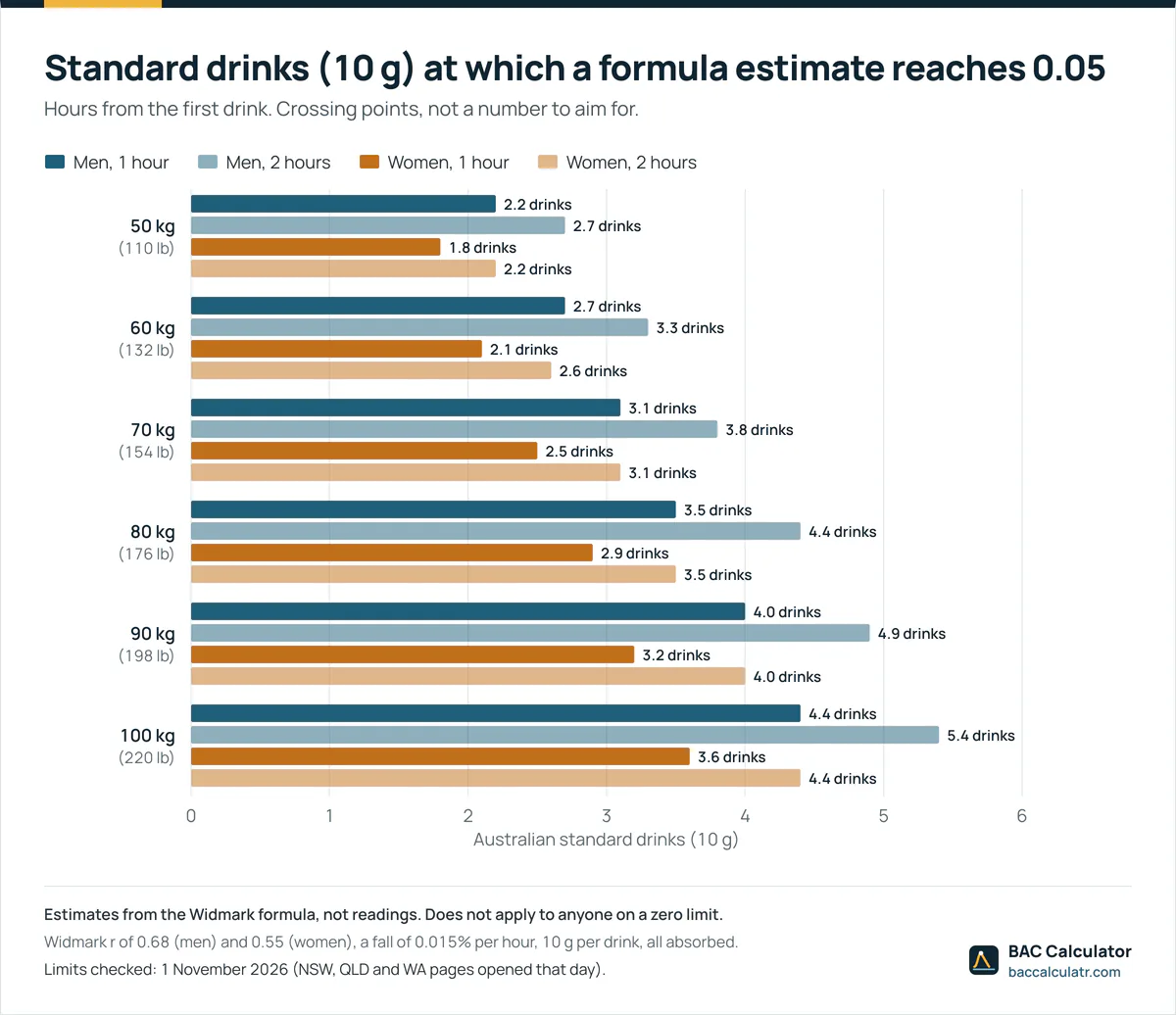
Assumptions: Widmark r of 0.68 (men) and 0.55 (women), a fall of 0.015% per hour, 10 g per drink, all absorbed, hours from the first drink.
| Body weight | Men, 1 hour | Men, 2 hours | Women, 1 hour | Women, 2 hours |
|---|---|---|---|---|
| 50 kg (110 lb) | 2.2 std drinks | 2.7 std drinks | 1.8 std drinks | 2.2 std drinks |
| 60 kg (132 lb) | 2.7 std drinks | 3.3 std drinks | 2.1 std drinks | 2.6 std drinks |
| 70 kg (154 lb) | 3.1 std drinks | 3.8 std drinks | 2.5 std drinks | 3.1 std drinks |
| 80 kg (176 lb) | 3.5 std drinks | 4.4 std drinks | 2.9 std drinks | 3.5 std drinks |
| 90 kg (198 lb) | 4.0 std drinks | 4.9 std drinks | 3.2 std drinks | 4.0 std drinks |
| 100 kg (220 lb) | 4.4 std drinks | 5.4 std drinks | 3.6 std drinks | 4.4 std drinks |
Each cell is an estimate for an average person; a breath or blood test is the only true reading. US tables count a 14 g drink, so the drink counts for 0.08 and 0.05 in US drinks are lower than these for the same person.
Why NSW says you cannot calculate your BAC
Transport for NSW calls trying to calculate your BAC "impossible". Victoria lets personal breath testers serve as a rough guide, yet warns drivers against trusting them.
FAQ
Is the drink driving limit Australia sets national?
For full licence holders, yes. The BAC limit Australia sets is 0.05 in every state and territory. What changes between states is who must be at zero and the truck weight where zero starts.
Is the breath limit different from the blood limit?
No. Australian law uses one number for both. Queensland defines 0.05 as 50 mg of alcohol in 100 mL of blood, and the NT measures breath per 210 litres exhaled. A breath reading of 0.05 therefore counts the same as a blood reading of 0.05.
Do overseas licence holders get the 0.05 limit?
A fully licensed visitor does. NSW places visitor licences under 0.05, and the NT names fully licensed interstate and overseas drivers in its 0.05 group. NSW holds visitors on an overseas or interstate learner or provisional licence to zero, the same as local L and P drivers.
What is the alcohol limit for WA truck drivers?
Zero, for vehicles over 22.5 t gross combination mass and for dangerous goods loads, according to WA's Road Safety Commission. Drivers of lighter trucks who hold a full licence fall under the general 0.05 limit, while bus and taxi drivers carrying passengers sit at zero.
Does a zero limit mean no alcohol at all?
Yes. South Australia's licence handbook says a zero BAC means no alcohol at all, so a single drink breaks it. The ACT Z condition allows 0 g of alcohol, whether measured in blood or breath.
Conclusion
Your licence and vehicle decide your line before any drink count matters, since a zero limit leaves no room for even one drink. On a full licence, staying inside the guide still cannot show that a breath test will read under 0.05. Until your BAC is back at 0.00, a breath test can still read alcohol. The window for each test is set out in how long alcohol stays on breath and in blood.