BAC Limit by State 2026
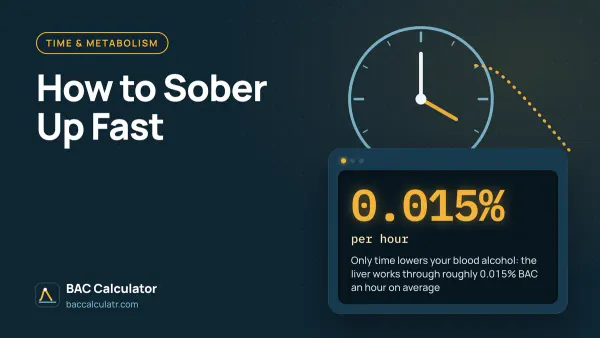
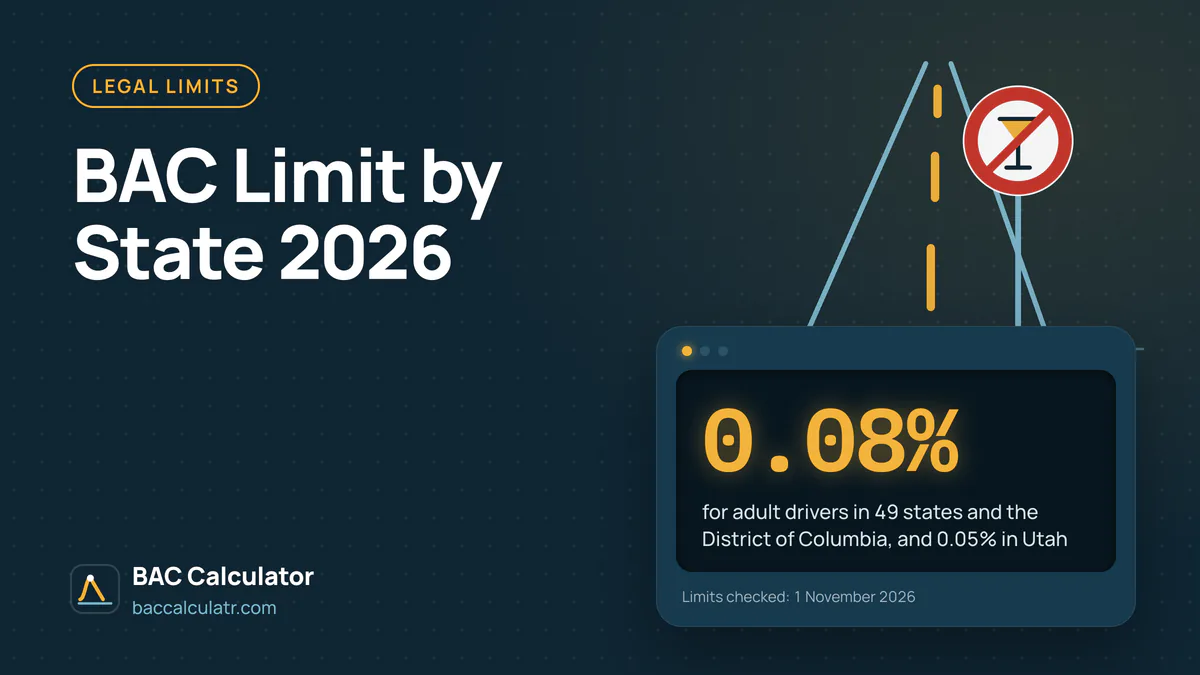
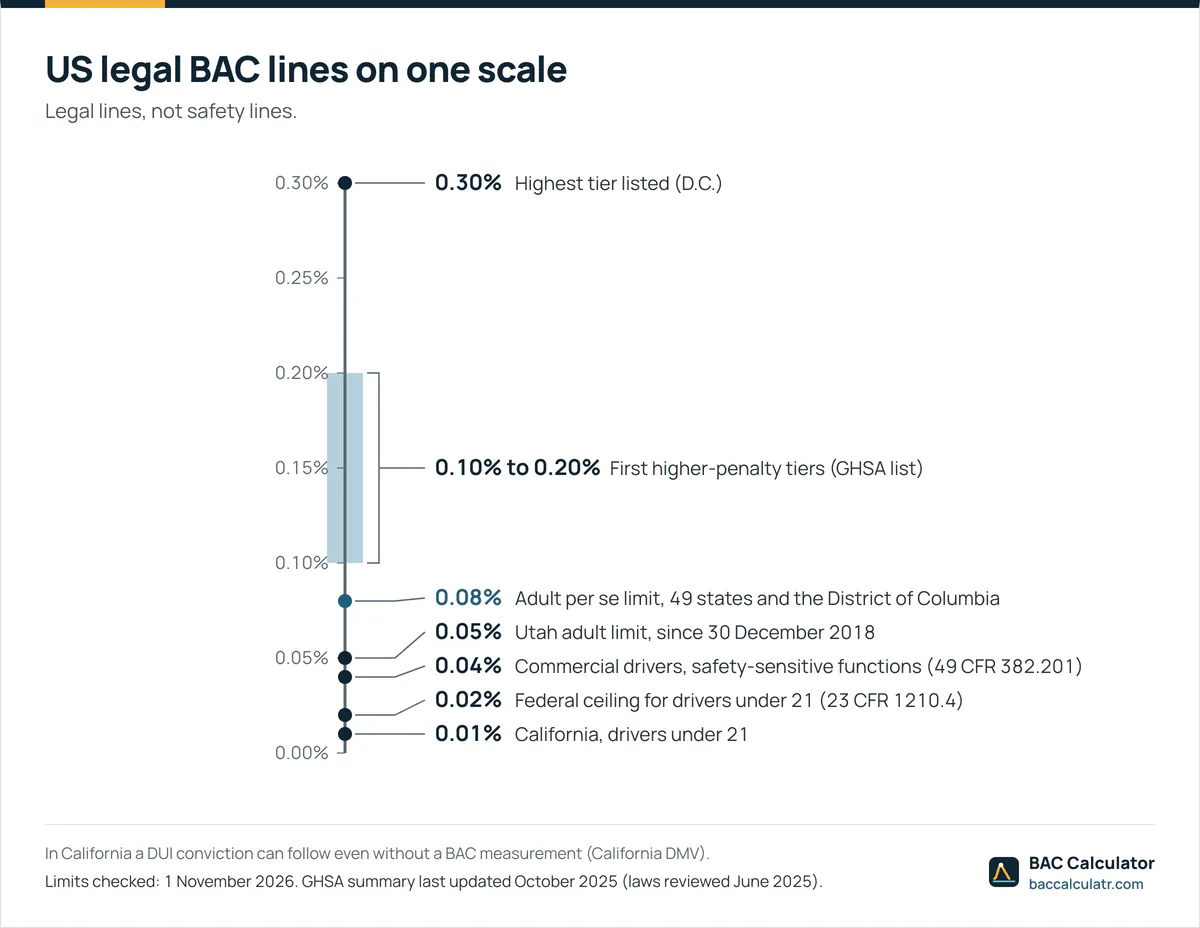
The BAC limit by state is 0.08% for adult drivers in 49 states and the District of Columbia, and 0.05% in Utah. Utah's lower limit took effect on 30 December 2018. Under 21, federal rules cap the limit at 0.02%. Commercial drivers have a 0.04% limit while performing safety-sensitive functions. In 44 states and D.C., a higher-penalty BAC starts somewhere from 0.10% to 0.20%.
Adult and higher-penalty lines in 51 places
Every row below shows a 0.08% adult limit except Utah at 0.05%, and 45 of the 51 rows add a higher-penalty BAC from 0.10% to 0.30%. Checking DUI BAC by state means reading two numbers in each row: the adult per se limit and the higher-penalty BAC.
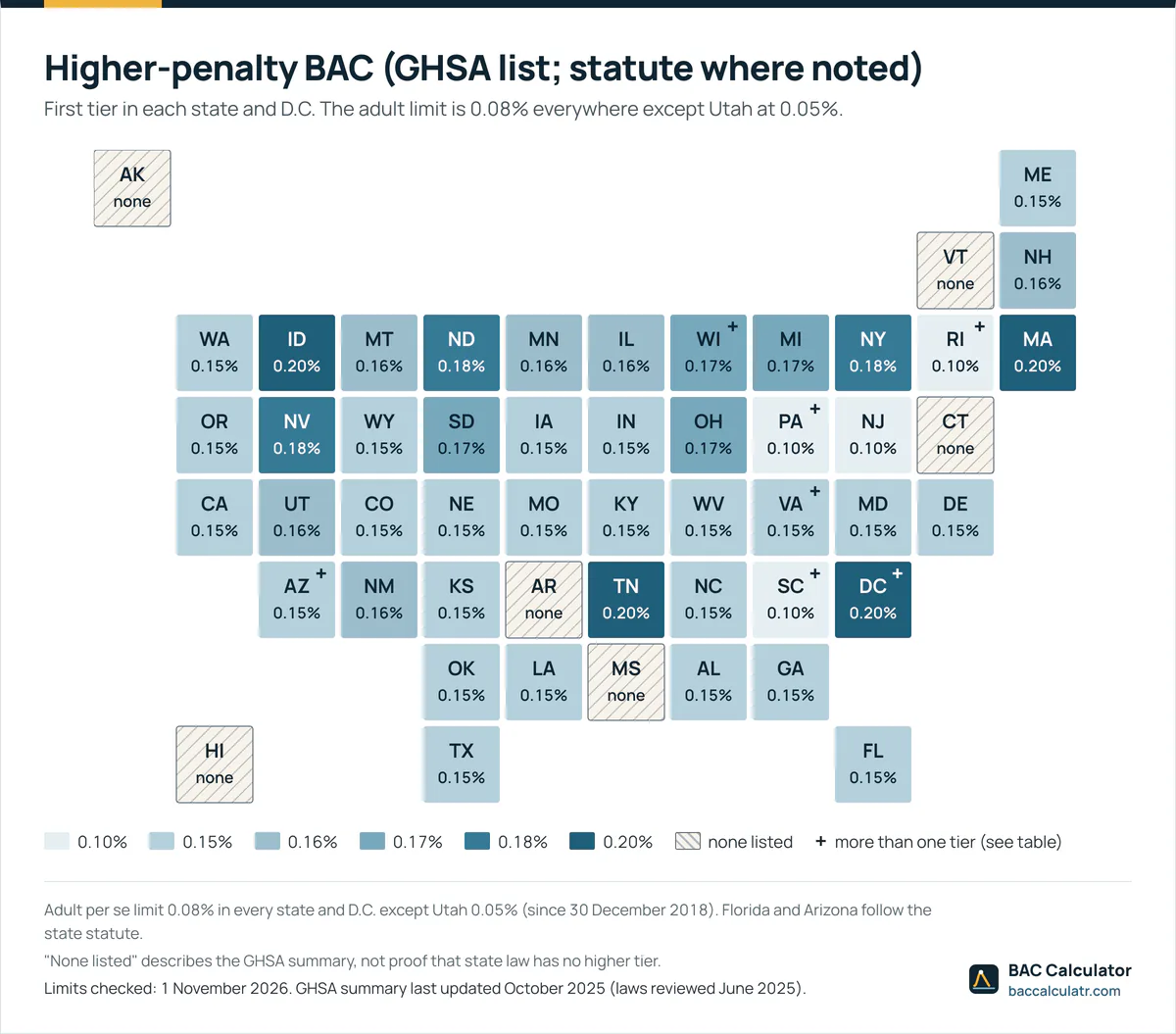
Most figures come from the Governors Highway Safety Association (GHSA) summary of state alcohol-impaired driving laws, last updated in October 2025. State highway safety offices reviewed those laws in June 2025. Where a state statute differs from that summary, the row follows the statute. That happens in Florida and Arizona.
Each limit applies to a breath or blood test result. A BAC calculator gives an estimate in the same % form from weight, drinks and hours, but an estimate is not a test, and a real reading can be higher.
| State | Adult per se limit | Higher-penalty BAC (GHSA list; statute where noted) | Source |
|---|---|---|---|
| Alabama | 0.08% | 0.15% | GHSA |
| Alaska | 0.08% | none listed | GHSA |
| Arizona | 0.08% | 0.15% and 0.20% | A.R.S. 28-1382 (GHSA lists 0.15% only) |
| Arkansas | 0.08% | none listed | GHSA |
| California | 0.08% | 0.15% | GHSA |
| Colorado | 0.08% | 0.15% | GHSA |
| Connecticut | 0.08% | none listed | GHSA |
| Delaware | 0.08% | 0.15% | GHSA |
| District of Columbia | 0.08% | 0.20%, 0.25% and 0.30% | GHSA |
| Florida | 0.08% | 0.15% | Fla. Stat. 316.193(4) (GHSA lists 0.20%) |
| Georgia | 0.08% | 0.15% | GHSA |
| Hawaii | 0.08% | none listed | GHSA |
| Idaho | 0.08% | 0.20% | GHSA |
| Illinois | 0.08% | 0.16% | GHSA |
| Indiana | 0.08% | 0.15% | GHSA |
| Iowa | 0.08% | 0.15% | GHSA |
| Kansas | 0.08% | 0.15% | GHSA; K.S.A. 8-1014 |
| Kentucky | 0.08% | 0.15% | GHSA |
| Louisiana | 0.08% | 0.15% | GHSA |
| Maine | 0.08% | 0.15% | GHSA |
| Maryland | 0.08% | 0.15% | GHSA |
| Massachusetts | 0.08% | 0.20% | GHSA |
| Michigan | 0.08% | 0.17% | GHSA |
| Minnesota | 0.08% | 0.16% | GHSA |
| Mississippi | 0.08% | none listed | GHSA |
| Missouri | 0.08% | 0.15% | GHSA |
| Montana | 0.08% | 0.16% | GHSA |
| Nebraska | 0.08% | 0.15% | GHSA |
| Nevada | 0.08% | 0.18% | GHSA |
| New Hampshire | 0.08% | 0.16% | GHSA |
| New Jersey | 0.08% | 0.10% | GHSA |
| New Mexico | 0.08% | 0.16% | GHSA |
| New York | 0.08% | 0.18% | GHSA |
| North Carolina | 0.08% | 0.15% | GHSA |
| North Dakota | 0.08% | 0.18% | GHSA |
| Ohio | 0.08% | 0.17% | GHSA |
| Oklahoma | 0.08% | 0.15% | GHSA |
| Oregon | 0.08% | 0.15% | GHSA |
| Pennsylvania | 0.08% | 0.10% and 0.16% | GHSA |
| Rhode Island | 0.08% | 0.10% and 0.15% | GHSA |
| South Carolina | 0.08% | 0.10% and 0.16% | GHSA |
| South Dakota | 0.08% | 0.17% | GHSA |
| Tennessee | 0.08% | 0.20% | GHSA |
| Texas | 0.08% | 0.15% | GHSA |
| Utah | 0.05% (since 30 Dec 2018) | 0.16% | GHSA |
| Vermont | 0.08% | none listed | GHSA |
| Virginia | 0.08% | 0.15% and 0.20% | GHSA |
| Washington | 0.08% | 0.15% | GHSA |
| West Virginia | 0.08% | 0.15% | GHSA |
| Wisconsin | 0.08% | 0.17%, 0.20% and 0.25% | GHSA |
| Wyoming | 0.08% | 0.15% | GHSA |
Limits checked: 1 November 2026. GHSA summary last updated October 2025 (laws reviewed June 2025).
Some states set more than one tier. Outside Florida and Arizona, the column shows only the tiers GHSA lists, so a state's law may hold a tier the table does not show.
Federal rule: states must set no higher than 0.02% for drivers under 21; some set lower, for example California at 0.01%.
Commercial drivers: 0.04% while performing safety-sensitive functions, under federal rule 49 CFR 382.201.
Can you get a DUI under the legal limit?
Yes, in California, by the state's own handbook. The California Department of Motor Vehicles (DMV) says an impaired driver can face arrest and be "convicted of a DUI even without a BAC measurement". These are California's rules, and each state writes its own.
Under the same handbook, driving in California means consenting to a breath, blood or urine test if an officer suspects DUI. The handbook warns that driving under the limit is not necessarily safe. NHTSA, the National Highway Traffic Safety Administration, puts steering trouble at 0.05% among its effects by BAC level.
What does the legal limit mean?
The DUI BAC limit of 0.08% is a concentration, not a share of your blood. Written out, a blood alcohol level legal limit of 0.08% stands for 0.08 g of ethanol per 100 mL of blood, which is 80 mg in that same 100 mL. A limit printed as "8%" would be 100 times higher.
Breath gets its own legal wording. After the blood form, Florida's statute sets "0.08 or more grams" of alcohol in each 210 liters of breath.
GHSA's summary says every state but Utah treats driving at or above 0.08% as a crime. That is what "per se" means here: the test result alone meets the offense.
Estimates use the same blood unit. How the Widmark formula turns grams into a BAC starts from body weight and the grams of alcohol drunk, and ends in grams per 100 mL of blood. What one US standard drink holds is about 14 g of alcohol. The legal figure counts alcohol itself. A urine ethyl glucuronide (EtG) test is different. It can find a breakdown product for a day or more after light drinking, as set out in the detection window of each alcohol test.
Which state has a 0.05 BAC limit?
Utah. Legal BAC levels by state line up at 0.08% for adults, with Utah the one exception at 0.05% since 30 December 2018. Utah was the first state to move to 0.05%, and GHSA still names it as the only one. NHTSA counts D.C. and Puerto Rico with the 0.08% group.
On GHSA's list, Utah's higher-penalty BAC is 0.16%, so its two lines sit 0.11 points apart. In a state with 0.08% and 0.15%, the gap is 0.07 points.
No single count matches Utah's line, because how many drinks reach Utah's 0.05% changes with weight, sex and hours.
DUI BAC over 0.15 and other higher tiers
A higher-penalty BAC is a second line above the per se limit, where state law sets a higher penalty. GHSA counts 44 states, D.C. and Guam with one, and Guam sits outside this table. GHSA files these figures under "Increased penalty for high BAC".
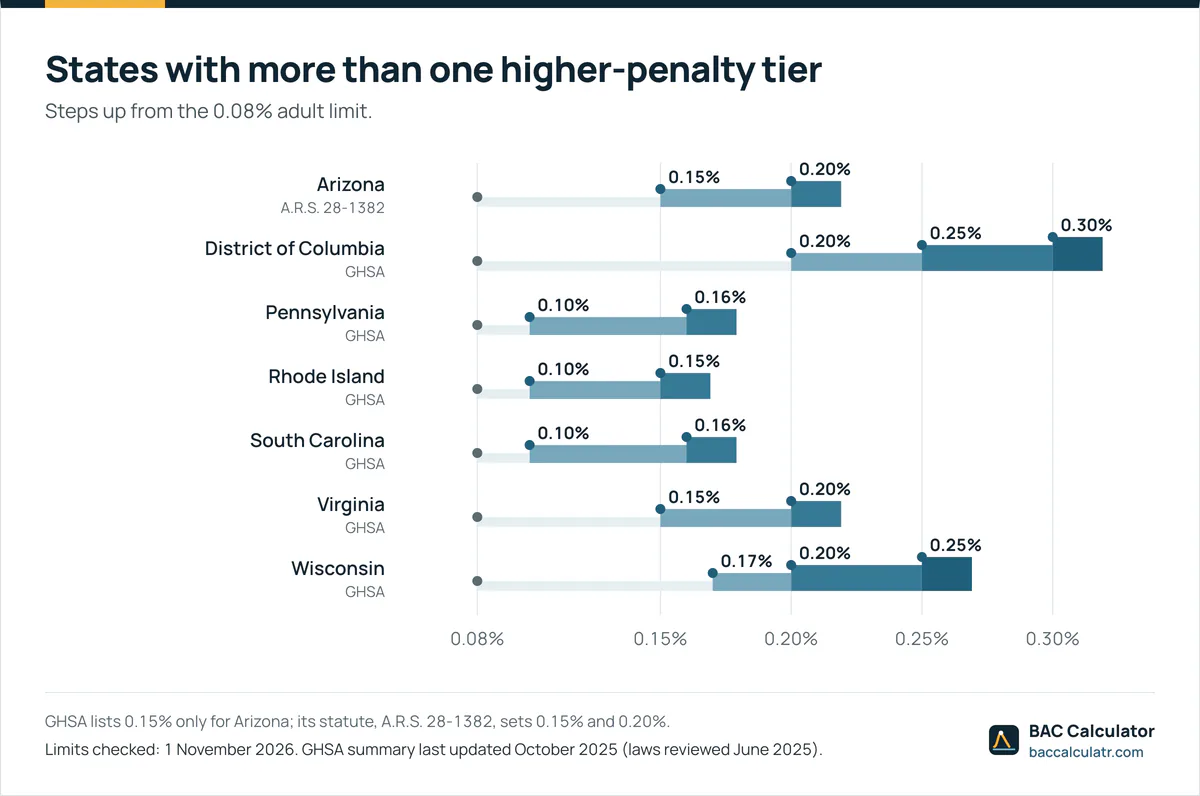
The most common first tier is 0.15%, used by 24 of the 45 places with a figure. Four start lower, at 0.10%: New Jersey, Pennsylvania, Rhode Island and South Carolina. Another four start at 0.20%, and six states have none listed.
Seven places set more than one tier: Arizona, D.C., Pennsylvania, Rhode Island, South Carolina, Virginia and Wisconsin. D.C. runs up to 0.30%, and Wisconsin up to 0.25%.
A 0.15% tier is about 1.9 times the 0.08% limit, and a 0.20% tier is 2.5 times. At 0.15%, NHTSA says a driver is at least 12 times as likely to crash as when sober.
Someone at a high BAC who cannot be woken or breathes slowly needs an ambulance now: dial 911, or the local number when outside the US. Tiers of 0.16% and up fall in the band MedlinePlus ties to "more serious signs of intoxication", which runs toward the BAC levels linked to alcohol poisoning.
Who gets a lower BAC limit?
Drivers under 21 and commercial drivers do, and both lower limits come from federal rules.
BAC limit for drivers under 21
Under 21, the line is 0.02% at most, one quarter of the adult limit. That ceiling comes from 23 CFR 1210.4, which withholds part of a state's highway funds if its under-21 limit is set higher.
A state may go lower. California's DMV handbook sets 0.01% for drivers under 21. People often call these rules zero tolerance, though the federal figure is 0.02%, not zero.
States set their own under-21 figure at or below that ceiling, so the table carries no under-21 column. A state's DMV handbook gives its figure.
A lighter body gives a higher BAC from the same drink, which the BAC chart by body weight lays out row by row.
Commercial driver BAC limit
A commercial driver's license (CDL) holder has a 0.04% limit while performing safety-sensitive functions, half the adult figure, under Federal Motor Carrier Safety Administration (FMCSA) rule 49 CFR 382.201. A reading of 0.04% or more while driving a commercial motor vehicle is a disqualifying offense under 49 CFR 383.51.
Two time rules sit next to that number. No alcohol may be used in the 4 hours before duty. A test from 0.02% to 0.039% takes the driver off duty for 24 hours.
The 4 hour rule is a gap in time, not a reading. BAC falls about 0.015% an hour on average, so how long BAC takes to fall to 0.00 depends on the level reached.
Why lists of the BAC limit by state disagree
State BAC limit lists disagree because many copy one summary, print one tier where a state has two, or drop the decimal point. The statute is the final text, which is why each row above names its source. These four mistakes turn up in state limit lists, set against what the source says.
| What a list may show | What the source says | Source |
|---|---|---|
| Florida higher-penalty BAC at 0.20% | 0.15% or higher | Fla. Stat. 316.193(4) |
| Arizona with one tier at 0.15% | 0.15% to under 0.20%, then 0.20% or more | A.R.S. 28-1382 |
| Limits printed as "8%" and "2%" | 0.08% and 0.02%, in grams per 100 mL of blood | NHTSA; 23 CFR 1210.4 |
| Under 21 at 0.02% in every state | 0.02% is a federal ceiling; California sets 0.01% | 23 CFR 1210.4; CA DMV |
Laws change, so a state legislature or DMV page dated after 1 November 2026 is the newer word.
FAQ
Is a 0.15 BAC a DUI in Texas?
Yes. A 0.15% reading is above the 0.08% per se limit Texas uses for adult drivers, and nearly twice it. It also matches the higher-penalty BAC that GHSA lists for Texas, so a 0.15% test reaches the first higher tier as well.
What is the DUI limit in California?
The California DMV handbook sets 0.08% for adult drivers and 0.01% for drivers under 21. It sets 0.04% for anyone driving a vehicle that needs a commercial license, or carrying a passenger for hire. GHSA lists 0.15% as California's higher-penalty BAC.
Can one beer put you over the legal limit?
For drivers under 21, it can. One 12 oz beer at 5%, fully absorbed, raises BAC by roughly 0.02% to 0.06% for people from 100 to 240 lb. That reaches or nears the 0.02% federal ceiling and passes California's 0.01%. Bigger or stronger beers add more, as how much one beer raises BAC by weight shows.
Which states have no higher-penalty BAC?
GHSA lists none for Alaska, Arkansas, Connecticut, Hawaii, Mississippi and Vermont. "None listed" describes the summary, not proof that state law has no higher tier. All six still use the 0.08% per se limit for adults.
Conclusion
For adults the BAC limit by state barely moves, so the table's real work is the higher-penalty column. It runs from 0.10% to 0.30%, and seven places use more than one tier. Each row names its source, with Florida and Arizona following their statutes over GHSA's summary. The UK writes its limits by nation in mg per 100 mL, and Australia sets its limits by licence type at 0.05 for a full licence.