How Many Drinks to Get to 0.08 BAC
In the first hour, a BAC estimate crosses 0.08% at about 2.5 to 5 US standard drinks for men and 2 to 4 for women of 120 to 240 lb. Weight and sex decide most of how many drinks to get to 0.08 BAC. Each extra hour moves the crossing point by less than one drink.
Crossing 0.08% at 1 hour and at 3 hours
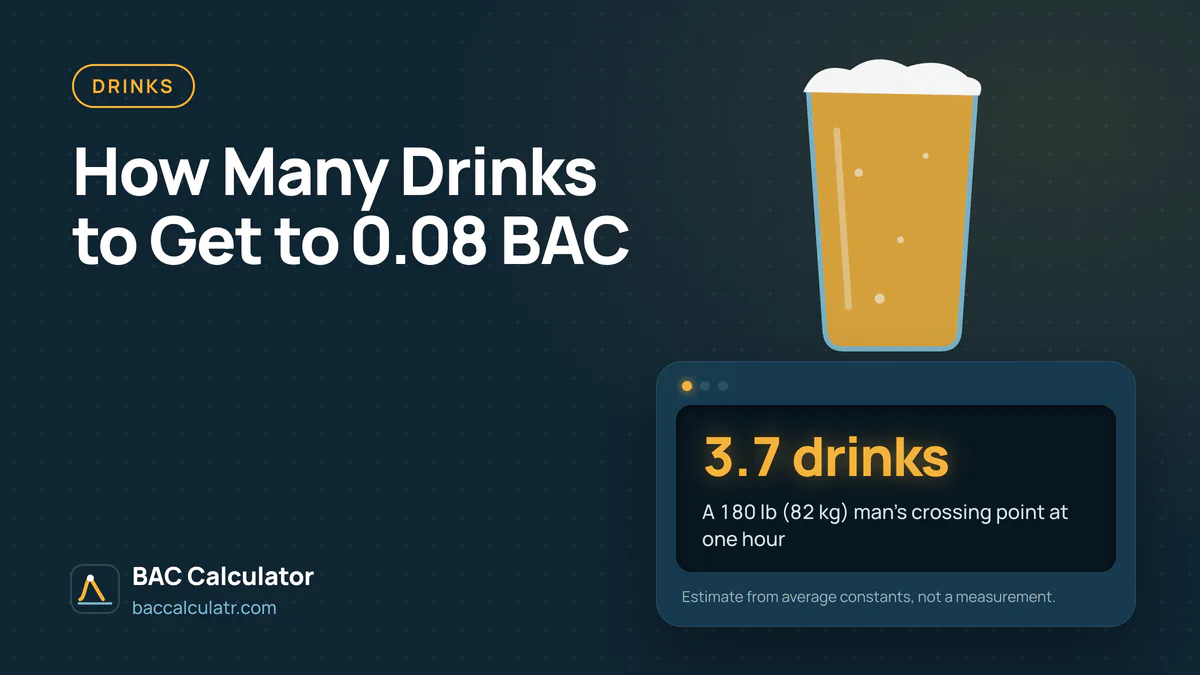
Three hours instead of one moves a 180 lb (82 kg) man's crossing point from about 3.7 drinks to 4.9. In blood, the 0.08% line means 80 mg of alcohol in each 100 mL, and the effects found at that level sit under what each BAC level means.
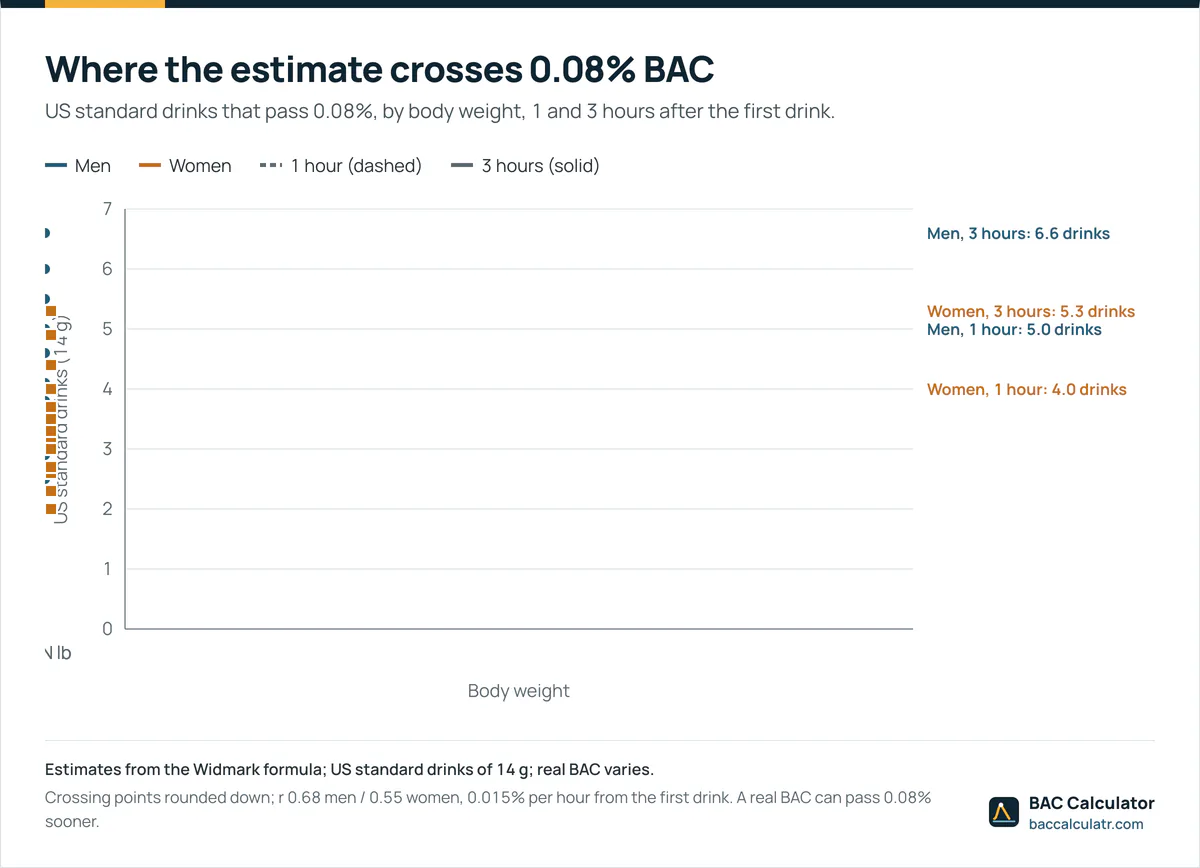
The columns answer how many drinks is 0.08% BAC for each weight. They give US standard drinks (14 g each) needed to pass the line, rounded down, timed from the first drink with r 0.68 or 0.55 and 0.015% cleared per hour.
| Body weight | Men, 1 hour (drinks) | Men, 3 hours (drinks) | Women, 1 hour (drinks) | Women, 3 hours (drinks) |
|---|---|---|---|---|
| Adult at 120 lb (54 kg) | 2.5 | 3.3 | 2.0 | 2.6 |
| Adult at 140 lb (64 kg) | 2.9 | 3.8 | 2.3 | 3.1 |
| Adult at 160 lb (73 kg) | 3.3 | 4.4 | 2.7 | 3.5 |
| Adult at 180 lb (82 kg) | 3.7 | 4.9 | 3.0 | 4.0 |
| Adult at 200 lb (91 kg) | 4.1 | 5.5 | 3.3 | 4.4 |
| Adult at 220 lb (100 kg) | 4.6 | 6.0 | 3.7 | 4.9 |
| Adult at 240 lb (109 kg) | 5.0 | 6.6 | 4.0 | 5.3 |
These counts are formula estimates, and a real BAC can pass 0.08% sooner. To put in your own weight, drinks and hours, estimate your own BAC with the calculator.
Time buys little: two extra hours add only 0.6 drinks for a 120 lb woman and 1.6 drinks for a 240 lb man.
Calculating how many drinks to get to 0.08 BAC
Consider a 150 lb (68 kg) woman two hours after her first drink. Adding back two hours of clearance, her estimate crosses 0.08% at about 2.9 drinks and 0.05% at about 2.1. As a check, three 5 oz glasses of 12% wine (42 g) put her at 0.082% at the two-hour mark. Each step of that math is laid out in the Widmark formula, symbol by symbol.
How many drinks is 0.05 BAC
A 180 lb man crosses 0.05% at about 2.5 drinks in one hour, and a 180 lb woman at about 2.0. This table keeps the same drink, factors and hourly clearance, with 0.05% as the line.
| Body weight | Men, 1 hour (drinks) | Men, 3 hours (drinks) | Women, 1 hour (drinks) | Women, 3 hours (drinks) |
|---|---|---|---|---|
| Adult at 120 lb (54 kg) | 1.7 | 2.5 | 1.3 | 2.0 |
| Adult at 140 lb (64 kg) | 2.0 | 2.9 | 1.6 | 2.3 |
| Adult at 160 lb (73 kg) | 2.2 | 3.3 | 1.8 | 2.7 |
| Adult at 180 lb (82 kg) | 2.5 | 3.7 | 2.0 | 3.0 |
| Adult at 200 lb (91 kg) | 2.8 | 4.1 | 2.3 | 3.3 |
| Adult at 220 lb (100 kg) | 3.1 | 4.6 | 2.5 | 3.7 |
| Adult at 240 lb (109 kg) | 3.4 | 5.0 | 2.7 | 4.0 |
The 0.05 line is Utah's legal limit, in force since 30 December 2018. The Utah Highway Safety Office says fatal crash risk is already significantly elevated by 0.05.
These tables use the US 14 g drink, so Australian drivers need the limits and drink sizes on drink driving limits in Australia.
How many beers is 0.08 BAC
In the first hour, 2.5 to 5 cans of 12 oz at 5% take men of 120 to 240 lb past 0.08%, and 2 to 4 do it for women. Every pour below carries more alcohol than the 14 g US standard drink.
| Pour | Standard drinks |
|---|---|
| Pint, 16 oz at 5% | 1.33 drinks |
| IPA, 16 oz at 7% | 1.87 drinks |
| Hard seltzer, 12 oz at 8% | 1.60 drinks |
| Wine, 8 oz glass at 13% | 1.73 drinks |
Two 7% IPAs add up to 3.73 drinks, which already passes the 3.3 drink crossing for a 160 lb man in one hour. Two large glasses of wine come to 3.46 drinks, past the 2.9 drink crossing for the 150 lb woman above at two hours.
How much one beer raises BAC gives the rise each size adds at several body weights.
Where the 4 or 5 drinks figure comes from
The "4 or 5 drinks" answer is borrowed from the binge drinking line set by the National Institute on Alcohol Abuse and Alcoholism (NIAAA), not from any driving rule. NIAAA says five or more drinks for a man, or four or more for a woman, in about two hours bring a typical adult to 0.08%.
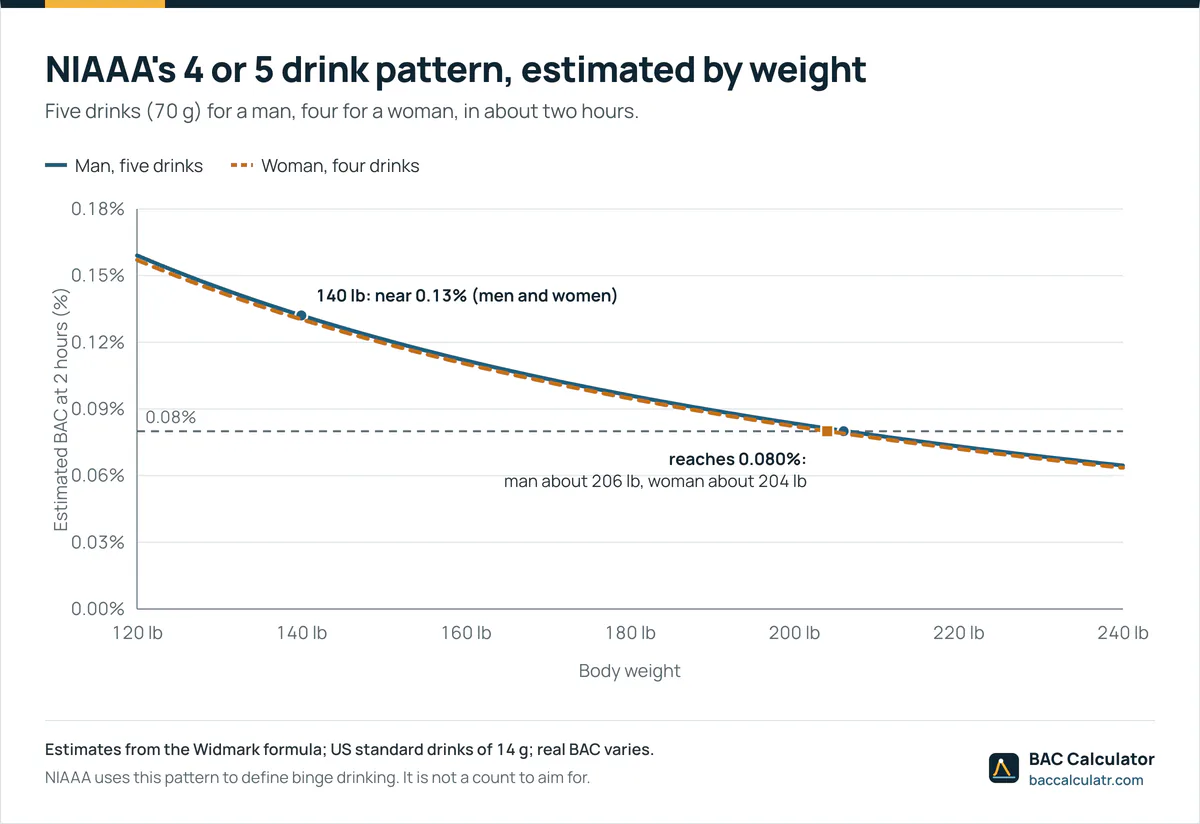
Through the same formula, five drinks (70 g of alcohol) in two hours reach 0.080% for a man of about 206 lb. Four drinks in two hours reach it for a woman of about 204 lb. A 140 lb person with the same drinks lands near 0.13%. A "4 or 5" answer therefore describes a fairly heavy adult. These weights explain the figure; they are not a count to aim for, and feeling drunk tracks BAC poorly, as the drink counts people report for feeling drunk show.
Why one drink per hour does not work
At 0.015% per hour, a 180 lb man clears about 0.6 standard drinks an hour, a 150 lb woman about 0.4, and a 120 lb woman about 0.3. Put in grams, the liver handles roughly 7 g of alcohol an hour at the low end, which is half a US standard drink.
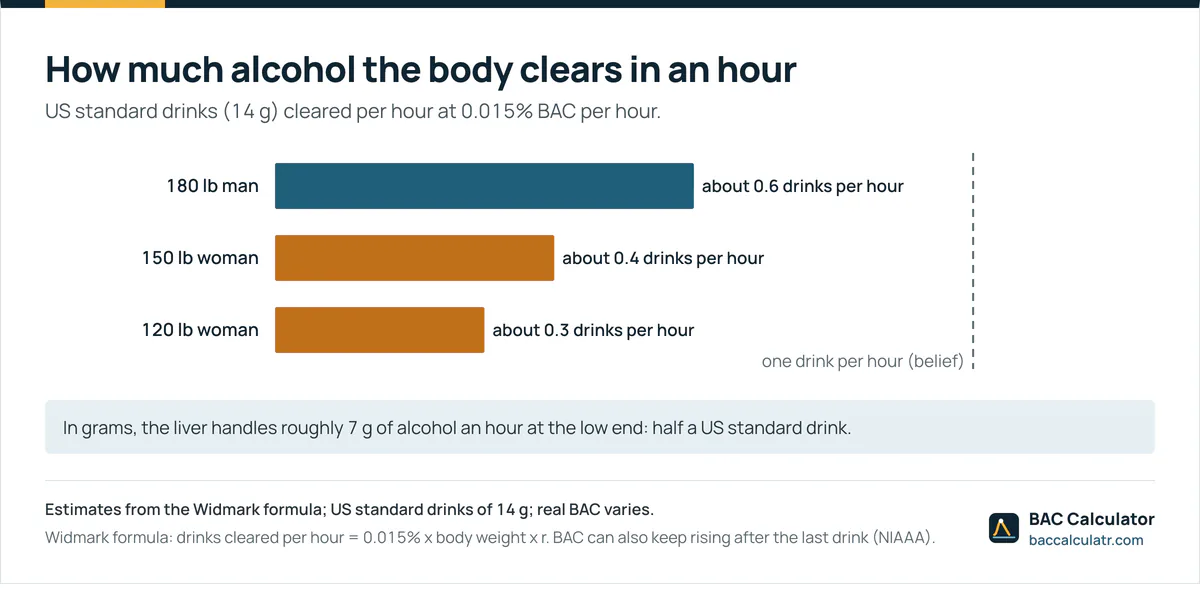
A pint of IPA counts as almost two drinks, so one IPA an hour is more than four times what a 150 lb woman clears. BAC can also keep rising after the last drink, according to the NIAAA, so a count taken at the bar reads low. At 0.015% an hour, a BAC of 0.08% takes more than five hours to fall to 0.00. The hours from each peak cover slower and faster clearers too.
Why your count can be lower than the table
Two things pull the crossing point earlier:
- Fast drinking on an empty stomach. Drinks downed quickly without food are absorbed within about an hour, so the whole round lands near the full estimate together. A large round taken that way can climb toward the levels where alcohol poisoning signs appear.
- Personal constants. Your own body water factor and clearance rate can sit well off the averages. For a 180 lb man at three hours, a slow clearer crosses 0.08% at 4.3 drinks and a faster one at 5.5.
Tools that pick other constants cross later: a 140 lb woman at two hours crosses at 2.7 drinks with 0.55, but 2.9 with the older fixed factor of 0.6. The BAC chart by weight and drinks turns the same constants into a BAC for each drink count instead of a crossing point.
How many drinks is over the limit for you
In the first hour, 2.0 to 5.0 drinks put most adults over 0.08%, and 0.7 to 1.8 drinks reach the 0.02% under-21 ceiling. The drink counts below are first-hour estimates for 120 to 240 lb, women at the low end.
| Driver | Legal line | Drinks to reach it in 1 hour |
|---|---|---|
| Adult, most states | 0.08% | 2.0 to 5.0 drinks |
| Adult, Utah | 0.05% | 1.3 to 3.4 drinks |
| Under 21 (federal ceiling) | 0.02% | 0.7 to 1.8 drinks |
| Commercial, on duty | 0.04% | 1.1 to 2.9 drinks |
The under-21 line is the most a state may set under 23 CFR 1210.4. Every line in force where you live is listed on BAC limits by state. Limits checked: 1 November 2026.
Impairment starts below 0.08
The 0.08 limit is a legal line, not the point where impairment begins. Impairment starts at lower levels too, according to the Centers for Disease Control and Prevention (CDC). Utah's highway safety office says the ability to drive begins to deteriorate below 0.05, and Utah officers make arrests based on observed impairment, not a BAC number alone.
The National Highway Traffic Safety Administration (NHTSA) uses 0.08 as a crash category: it labels drivers at 0.08 and above as alcohol impaired. Yet in 2023 it counted 2,117 deaths in crashes involving a driver at a BAC from 0.01% to 0.07%.
So if the question is "am I over the limit to drive", a drink count cannot tell you. A count below a crossing point is not a safe number, and NHTSA notes that failing to recognize impairment is often a symptom of it.
FAQ
Are three beers over the limit?
Three 12 oz beers at 5% in one hour push the estimate past 0.08% for men under about 143 lb and women under about 177 lb. A 160 lb woman crosses at 2.7 drinks. Heavier people cross later, but impairment starts below the limit, according to the CDC.
How many glasses of wine reach 0.08%?
Wine poured at 5 oz and 12% is one standard drink, so the 0.08% table counts those glasses directly. An 8 oz glass at 13% holds 1.73 drinks, so fewer real glasses reach each crossing point than the table shows.
How many shots to reach 0.08%?
A 1.5 oz shot of 40% ABV spirits is one US standard drink, so shot counts match the 0.08% table. A 180 lb man crosses 0.08% at about 3.7 shots in one hour, and a 180 lb woman at about 3.0. A double counts as two drinks.
How many drinks is 0.02 BAC?
Across 120 to 240 lb, the estimate passes 0.02% after about 0.7 to 1.8 drinks taken within an hour. For lighter people, one drink can pass it. That is the 0.02% line in the table above.
Does eating change how many drinks it takes?
Food slows absorption, so BAC rises more slowly after a meal. Without food, the peak tends to come within the first hour, which is why the tables match an empty-stomach round best. The tables use 0.015% per hour and assume no food delay.
Why do women cross 0.08% on fewer drinks?
At equal weight, a woman crosses with about a fifth fewer drinks: 3.0 drinks for a 180 lb woman in one hour against 3.7 for a 180 lb man. The tables' body water factors, 0.55 for women and 0.68 for men, make that gap.
Conclusion
Each crossing point in the tables marks where an average body passes the line, not a count of drinks to stop at. Strong pours and fast rounds on an empty stomach bring that point forward. England and Wales set their blood limit at this same 0.08%, while Scotland's 0.05% and the breath figures for each nation are in the UK drink driving limit.