BAC Levels and Effects
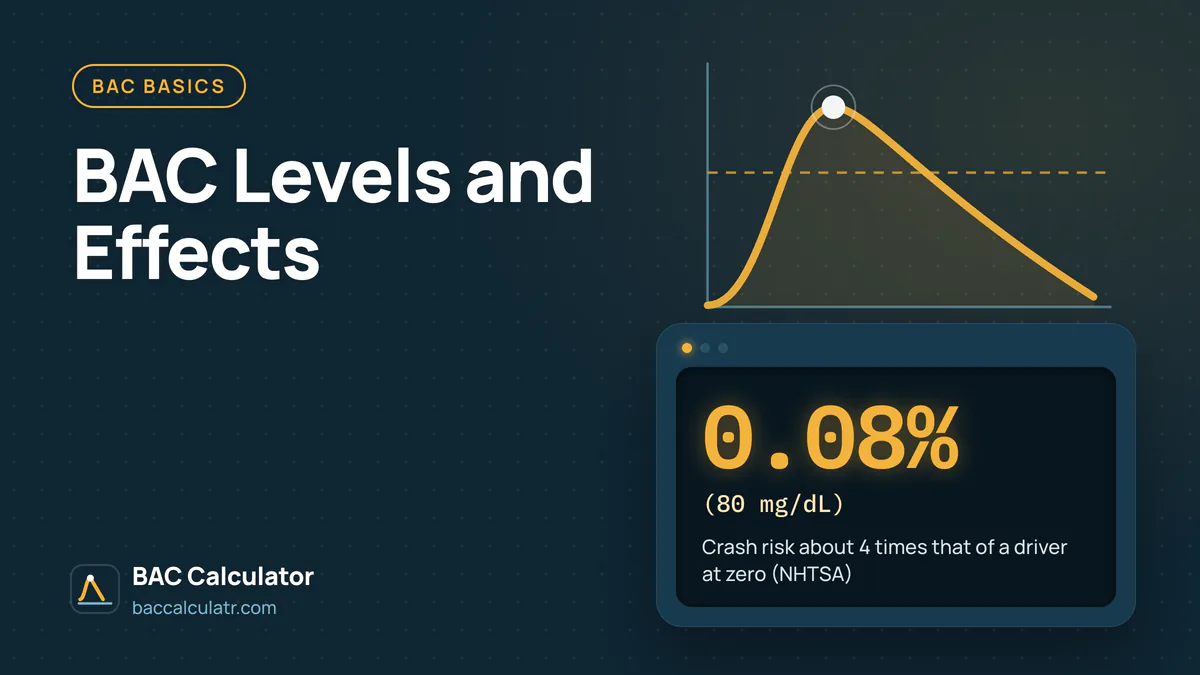
BAC levels give the alcohol in your blood as a percent: at 0.08%, every 100 mL of blood carries 0.08 g of alcohol. The federal National Highway Traffic Safety Administration (NHTSA) charts effects from 0.02% upward, and by 0.08% coordination is poor and judgment and memory are impaired. MedlinePlus says levels over 0.31% may be fatal.
Blood alcohol concentration definition
Blood alcohol concentration (BAC) is the weight of alcohol in a set volume of blood. The blood alcohol concentration definition NHTSA and US law use is grams per deciliter, and a deciliter is 100 mL. So 0.08% and 0.08 g/dL are the same number. It is weight in a volume, not alcohol by volume like a beer label. Calculators estimate it from drinks, weight, sex and hours with the Widmark formula. The BAC calculator returns a percent in this same g/dL form, so its number reads straight off the effects chart below.
BAC levels and effects chart
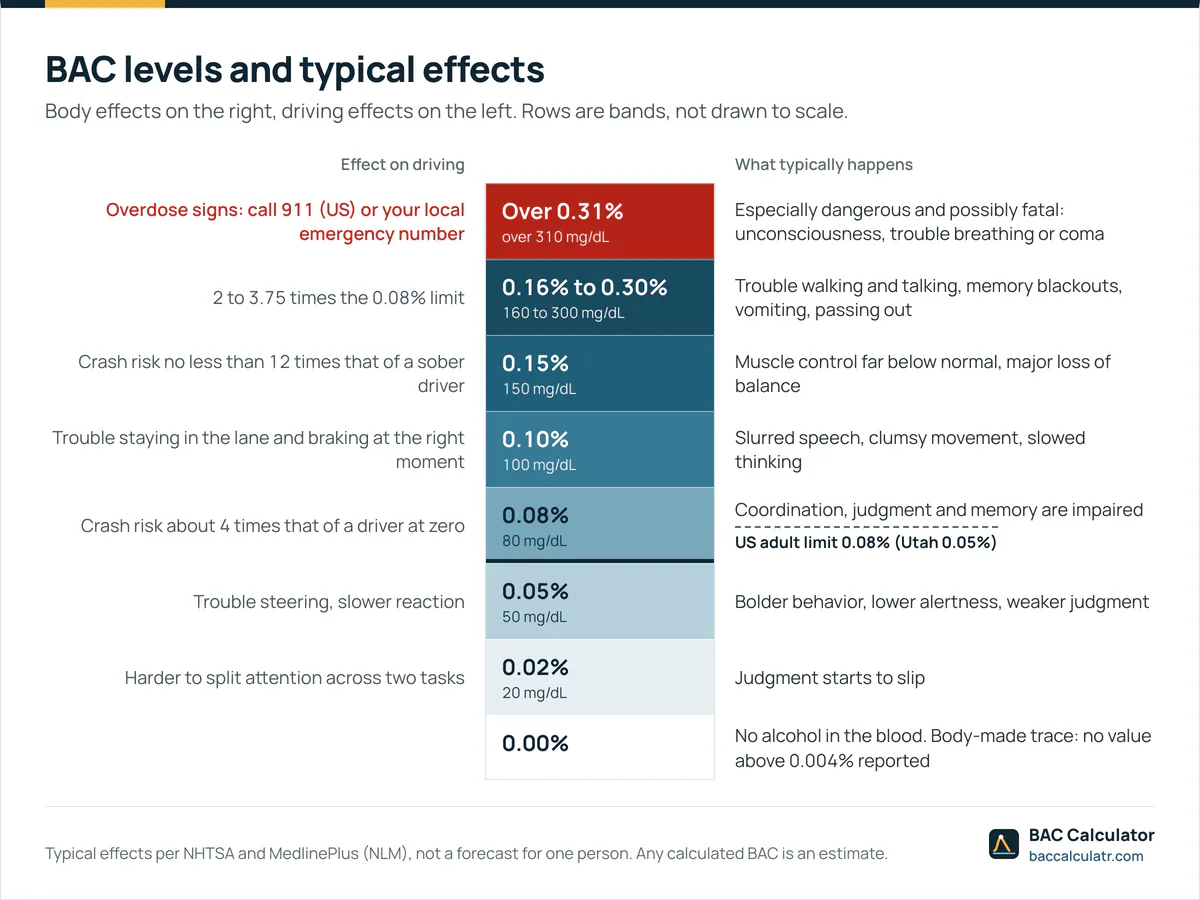
Effects begin at 0.02%, and by 0.15% control of a car is badly impaired. The blood alcohol level chart below sets body effects beside road effects, drawing on NHTSA's effects table for 0.02% to 0.15%. The two highest bands come from MedlinePlus (National Library of Medicine).
| BAC level | What typically happens | Effect on driving | Source |
|---|---|---|---|
| 0.02% (20 mg/dL) | Relaxed and slightly warm, mood shifts, judgment starts to slip | Harder to follow a moving object by eye or split attention across two tasks | NHTSA |
| 0.05% (50 mg/dL) | Bolder, louder behavior, fewer inhibitions, less alert, weaker judgment, eye focus may lag | Weaker coordination, trouble steering, slower reaction when something goes wrong ahead | NHTSA |
| 0.08% (80 mg/dL) | Balance, speech, sight, hearing and reaction time all suffer; thinking, memory and self-control are impaired; danger is harder to notice | Weaker focus and speed control, short-term memory gaps, slower handling of signals and what you see | NHTSA |
| 0.10% (100 mg/dL) | Clearly slower reactions, slurred speech, clumsy movement, slowed thinking | Trouble staying in the lane and braking at the right moment | NHTSA |
| 0.15% (150 mg/dL) | Muscle control far below normal, major loss of balance, vomiting possible | Severe impairment in steering, attention and taking in sights and sounds | NHTSA |
| 0.16% to 0.30% (160 to 300 mg/dL) | Trouble walking and talking, drowsy, confused, nauseated, memory blackouts, vomiting, passing out; 2 to 3.75 times the 0.08% limit | Not charted by NHTSA | MedlinePlus (NLM) |
| Over 0.31% (over 310 mg/dL) | Especially dangerous and possibly fatal; unconsciousness, trouble breathing or coma; more than 3.8 times the 0.08% limit | Not charted by NHTSA | MedlinePlus (NLM) |
The BAC effects chart describes a typical drinker at each row, not a forecast for you, and a calculator's BAC is a formula's guess rather than a blood test. Equal drinks land on different rows for a light and a heavy person, which the BAC chart by weight lays out drink by drink.
What each BAC number means
Each step up the scale adds a new effect, and NHTSA attaches crash-risk figures to the 0.08% and 0.15% steps.
0.02% BAC
NHTSA lists its first effects at 0.02% (20 mg/dL), and it counted 2,117 people killed in 2023 in crashes where a driver was at 0.01% to 0.07%. One US standard drink holds about 14 g of alcohol, and how much one beer raises BAC depends on your size and sex.
0.05% BAC
At 0.05% (50 mg/dL), NHTSA lists bolder behavior, lower alertness and trouble steering.
Is 0.08 BAC bad?
Yes. At 0.08% (80 mg/dL), coordination, judgment and memory are impaired, and NHTSA puts crash risk at about 4 times that of a driver at zero. The BAC limit in each state is 0.08% for adult drivers in every state, DC and Puerto Rico except Utah, which uses 0.05%; some drivers face lower limits. How many drinks reach 0.08 depends on weight, sex and time.
0.10% BAC
At 0.10% (100 mg/dL), BAC is 1.25 times the 0.08% limit, and NHTSA first lists slurred speech.
Is 0.15 BAC a lot?
Yes. At 0.15% (150 mg/dL), NHTSA puts crash risk at no less than 12 times that of a sober driver. Vomiting may not happen if the level was reached slowly or the person has built up a tolerance, NHTSA notes, so its absence proves nothing.
0.20% BAC and higher
Reaching 0.20% (200 mg/dL) means 2.5 times the 0.08% limit, inside the MedlinePlus band of 0.16% to 0.30% where blackouts, vomiting and passing out can happen.
Dangerous BAC levels
Very high BAC can slow or stop breathing. Confusion, a seizure, very slow breaths or a person you cannot rouse all mean calling 911 right away, or the local emergency number of the country you are in. That is the advice of the National Institute on Alcohol Abuse and Alcoholism (NIAAA) in its guide to the dangers of an overdose. Above 0.31% the MedlinePlus band turns possibly fatal, and the alcohol poisoning signs and first steps cover what to do while help comes.
Tipsy, buzzed, drunk and legally drunk
Tipsy, buzzed and drunk are informal words for how someone feels and looks, not levels to aim for, and none of the agencies cited here gives them a BAC number. Loosely, the relaxed, less careful state NHTSA lists at 0.02% to 0.05% is what people call tipsy or buzzed. The clumsy movement and slurred speech of 0.08% to 0.10% is what most people mean by drunk. "Legally drunk" is shorthand for the per se limit in the 0.08% section above. People also rate themselves less drunk as BAC falls than at the same level on the way up, which is why feeling sober is not a lower BAC. The drinks it takes to get drunk shift with size, food and pace.
Does BAC keep rising after you stop drinking?
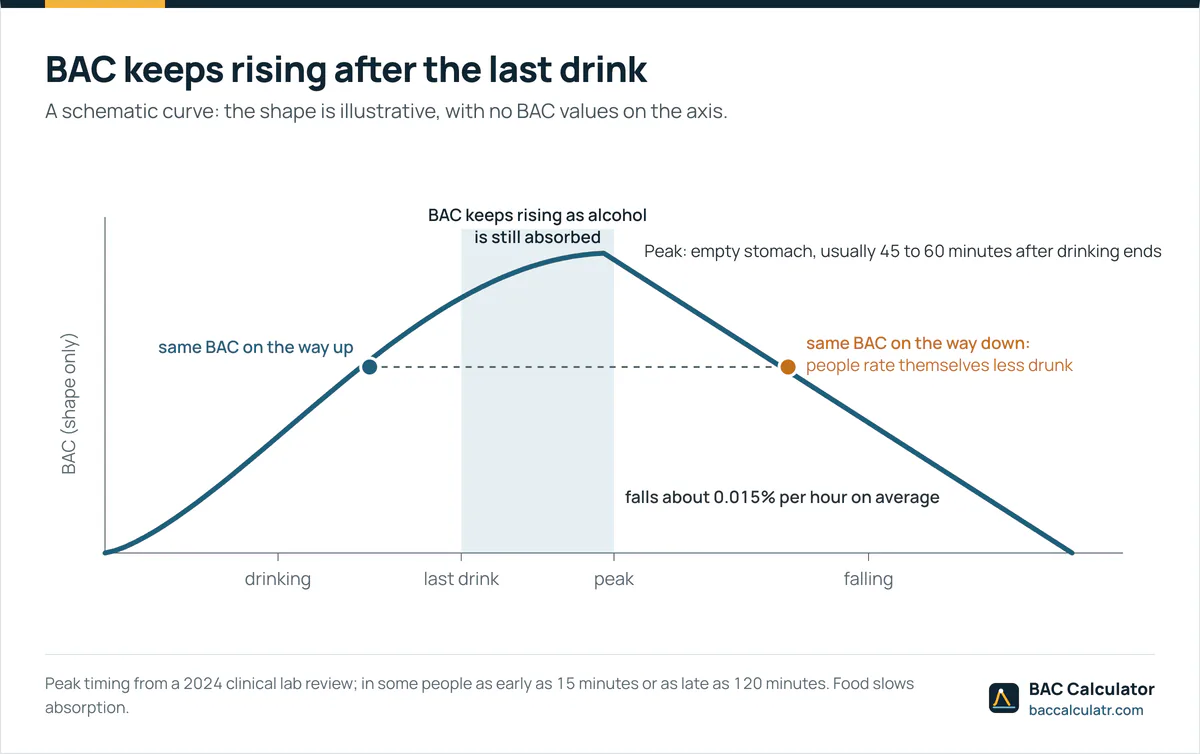
Yes. Alcohol still in your stomach and intestine keeps entering the blood after the last drink, so BAC can climb for a while. On an empty stomach, the peak usually arrives 45 to 60 minutes after drinking ends, according to Ialongo's 2024 clinical review. In some people it comes as early as 15 minutes or as late as 120 minutes from the time of drinking, and food slows absorption. A number taken right after the last drink is often not the peak. Past the peak, BAC drops by roughly 0.015% an hour on average, and the hours to 0.00 from each peak follow from that rate.
BAC in mg/dL and other hospital units
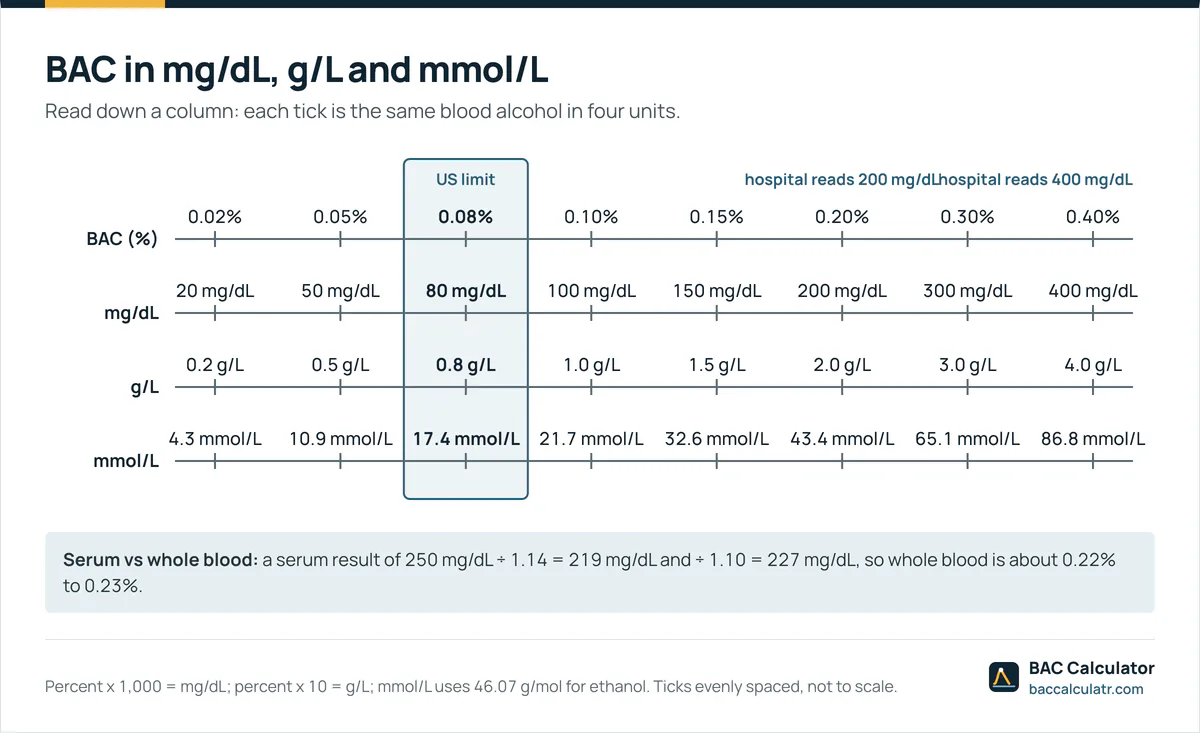
A hospital reading of 200 means 200 mg/dL, which is a BAC of 0.20%. To convert, multiply the percent by 1,000 for mg/dL or by 10 for g/L. The table converts common readings, using ethanol's molar mass of 46.07 g/mol for mmol/L.
| BAC (%) | mg/dL | g/L | mmol/L | Times the 0.08% limit |
|---|---|---|---|---|
| 0.02% | 20 mg/dL | 0.2 g/L | 4.3 mmol/L | 0.25 times |
| 0.05% | 50 mg/dL | 0.5 g/L | 10.9 mmol/L | 0.63 times |
| 0.08% | 80 mg/dL | 0.8 g/L | 17.4 mmol/L | 1.00 times |
| 0.10% | 100 mg/dL | 1.0 g/L | 21.7 mmol/L | 1.25 times |
| 0.15% | 150 mg/dL | 1.5 g/L | 32.6 mmol/L | 1.88 times |
| 0.20% | 200 mg/dL | 2.0 g/L | 43.4 mmol/L | 2.50 times |
| 0.30% | 300 mg/dL | 3.0 g/L | 65.1 mmol/L | 3.75 times |
| 0.40% | 400 mg/dL | 4.0 g/L | 86.8 mmol/L | 5.00 times |
Serum vs whole blood readings
Hospital labs often test serum or plasma, which reads about 1.10 to 1.14 times higher than whole blood on average, per Ialongo's 2024 clinical review. The ratio varies by person. Take a serum result of 250 mg/dL: 250 ÷ 1.14 = 219 mg/dL and 250 ÷ 1.10 = 227 mg/dL. The whole-blood estimate is about 0.22% to 0.23%, roughly 2.7 to 2.8 times the 0.08% limit.
Normal BAC and alcohol your body makes
A normal BAC is 0.00% for someone who has not been drinking. The body makes trace ethanol on its own. Ialongo's review finds 95% of sober people at or below 0.012 g/L (0.0012%) and 99.4% at or below 0.020 g/L (0.002%). No value above 0.040 g/L (0.004%) has been reported. Auto-brewery (gut fermentation) syndrome is rare: the same review counts no more than 20 correctly identified cases up to 2021. In those cases BAC reached as high as 0.5 g/L (0.05%), and up to 2.0 g/L (0.20%) after a heavy carbohydrate load.
FAQ
Is blood alcohol level a percentage?
Yes, in the US. A reading of 0.08% stands for 0.08 g of alcohol per deciliter (100 mL) of blood; it does not mean 8% of your blood is alcohol. Labs may write the same result as 80 mg/dL or 0.8 g/L.
Can your blood alcohol level be 1.0 or 2.0?
A reading of 1.0 is usually in g/L, which equals 0.10%, or a figure in other units mistaken for a percent. A true 1.0% BAC would be 1,000 mg/dL. Likewise, 2.0 g/L equals 0.20% and 1.2 g/L equals 0.12%.
Is a 0.12 BAC drunk?
A 0.12% BAC is in the range most people call drunk. At 0.12% (120 mg/dL), BAC is 1.5 times the 0.08% limit. It sits between NHTSA's 0.10% and 0.15% rows, where slurred speech, slowed thinking and trouble braking or holding a lane are typical.
What does a blood alcohol level of 400 mean?
A hospital blood alcohol level of 400 means 400 mg/dL, a BAC of 0.40%. That is five times the 0.08% limit and well past the 0.31% mark MedlinePlus calls possibly fatal. If the lab tested serum, the whole-blood figure is about 0.35% to 0.36%.
Conclusion
Read any BAC number against the effects table, and convert a hospital result to a percent first if it came in mg/dL or g/L. Drink counts depend on pour size, so check what counts as a standard drink. Blood BAC is one test among several, and how long alcohol shows up on tests varies by the test used.