How Long Does It Take to Sober Up?
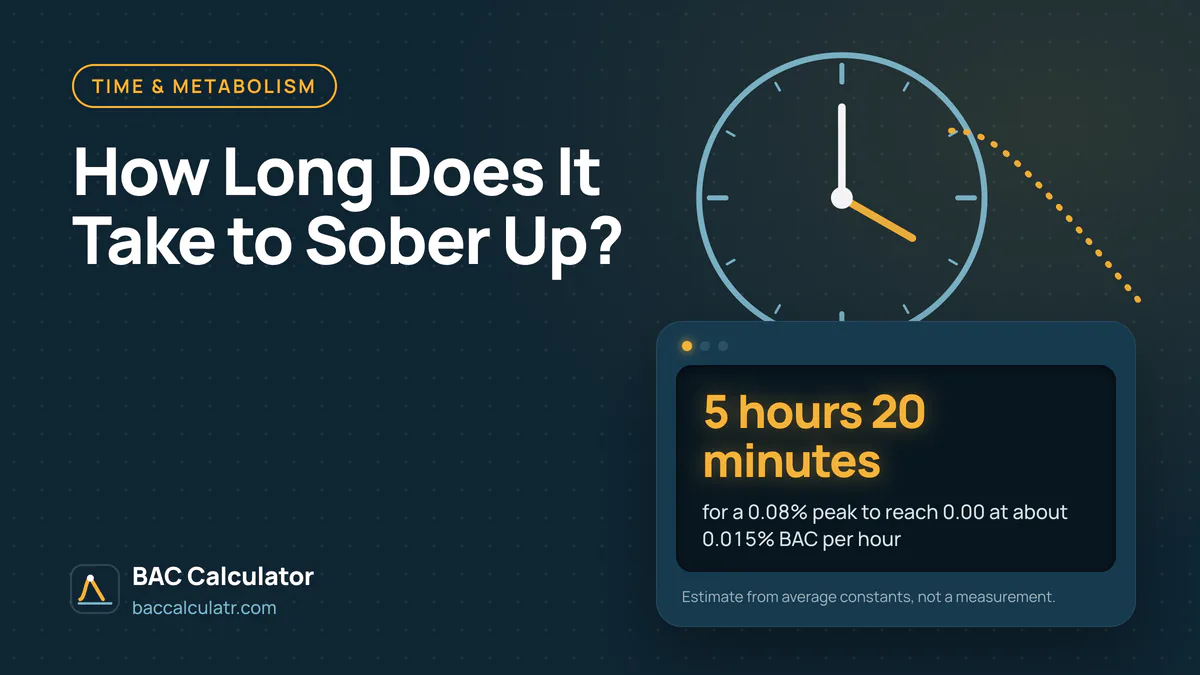
How long to sober up depends on your peak BAC, because the body clears about 0.015% BAC per hour on average. At that rate a 0.08% peak needs about 5 hours 20 minutes to reach 0.00, and a 0.15% peak about 10 hours. Real rates run slower or faster, so the table gives three.
Divide your peak by the clearance rate
To work out how long to sober up, divide your peak BAC by the rate your body clears it. At the average 0.015% per hour, each 0.01% of BAC takes about 40 minutes to clear. The table shows the estimated hours from a peak down to 0.00 at three steady rates drawn from A. W. Jones's 2010 review: a slow 0.010%, the average 0.015% and a faster 0.020% per hour.
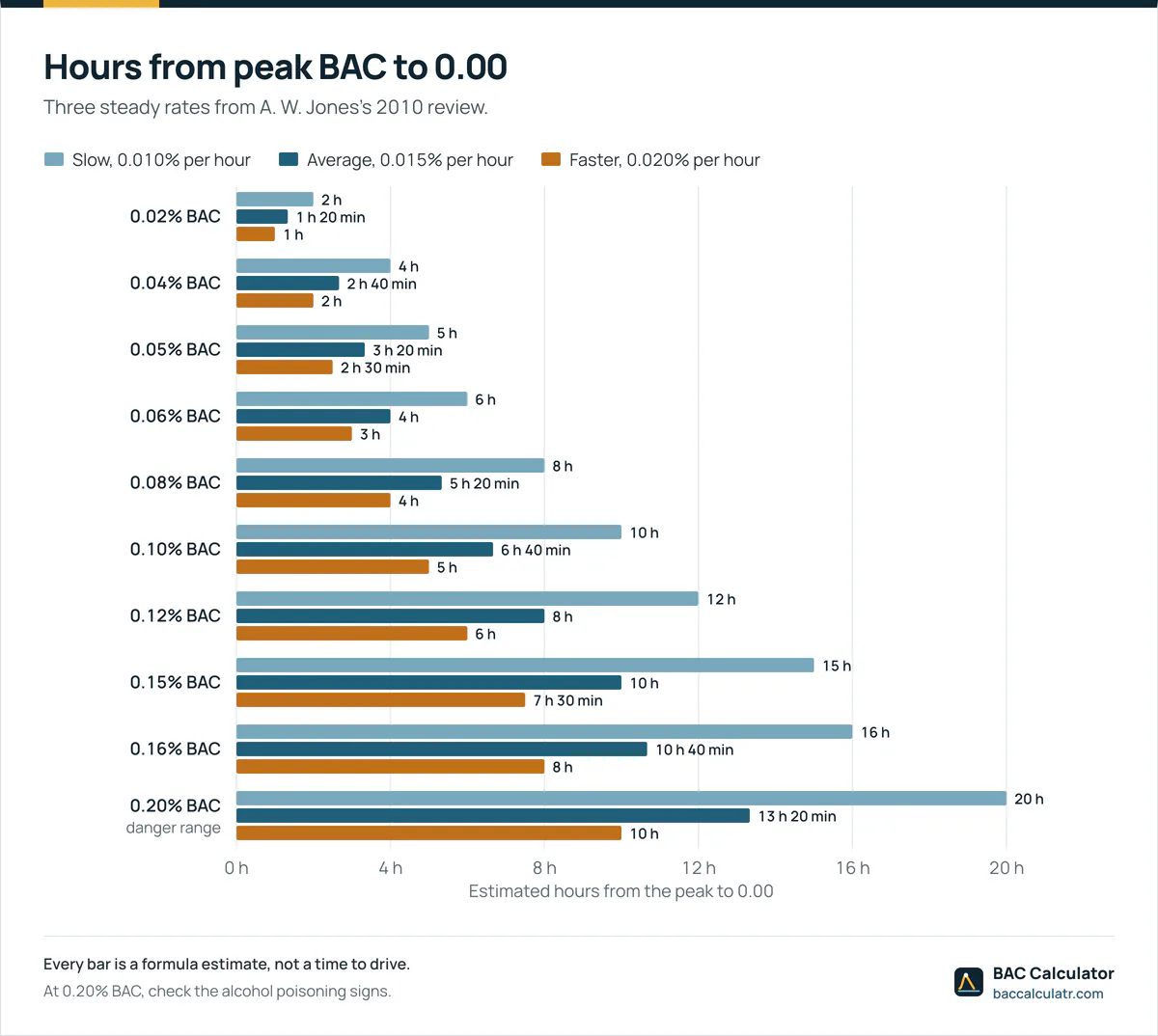
| Peak BAC | Slow, 0.010% per hour | Average, 0.015% per hour | Faster, 0.020% per hour |
|---|---|---|---|
| 0.02% BAC | 2 h | 1 h 20 min | 1 h |
| 0.04% BAC | 4 h | 2 h 40 min | 2 h |
| 0.05% BAC | 5 h | 3 h 20 min | 2 h 30 min |
| 0.06% BAC | 6 h | 4 h | 3 h |
| 0.08% BAC | 8 h | 5 h 20 min | 4 h |
| 0.10% BAC | 10 h | 6 h 40 min | 5 h |
| 0.12% BAC | 12 h | 8 h | 6 h |
| 0.15% BAC | 15 h | 10 h | 7 h 30 min |
| 0.16% BAC | 16 h | 10 h 40 min | 8 h |
| 0.20% BAC | 20 h | 13 h 20 min | 10 h |
Every cell is a formula estimate. Your own rate is unknown, and a 2005 BMJ article by Paton notes that it "varies in different people", so you could sit outside all three columns.
Each count in the table runs to 0.00. It is not a time to drive.
A drunk person who cannot be woken or breathes very slowly needs an ambulance now: call 911 in the US or the local emergency number abroad. The alcohol poisoning signs and BAC levels cover the next steps.
The table needs a peak, and a BAC calculator estimates one from your weight, drinks and hours. For adults from 100 to 240 lb (45 to 109 kg), one 14 g US drink lands in the first four rows. BAC after one beer gives the figure for each weight.
From 0.08 or 0.15 BAC to zero
Going from 0.08 BAC to zero takes about 5 hours 20 minutes at the average rate, and 4 to 8 hours across the three columns. From 0.15 BAC to zero takes about 10 hours on average, with a spread of 7 hours 30 minutes to 15 hours. The higher the peak, the wider the gap between slow and fast clearers: 4 hours apart at 0.08%, but 7 hours 30 minutes apart at 0.15%. A 0.08% BAC works out to 80 mg in each 100 mL of blood, and how many drinks reach 0.08% depends on your weight and sex.
When does blood alcohol level return to zero?
Blood alcohol returns to zero once your peak has had time to clear, so the sober-by clock starts at the peak, not at your last drink. BAC levels can keep climbing after drinking stops, often for 45 to 60 minutes.
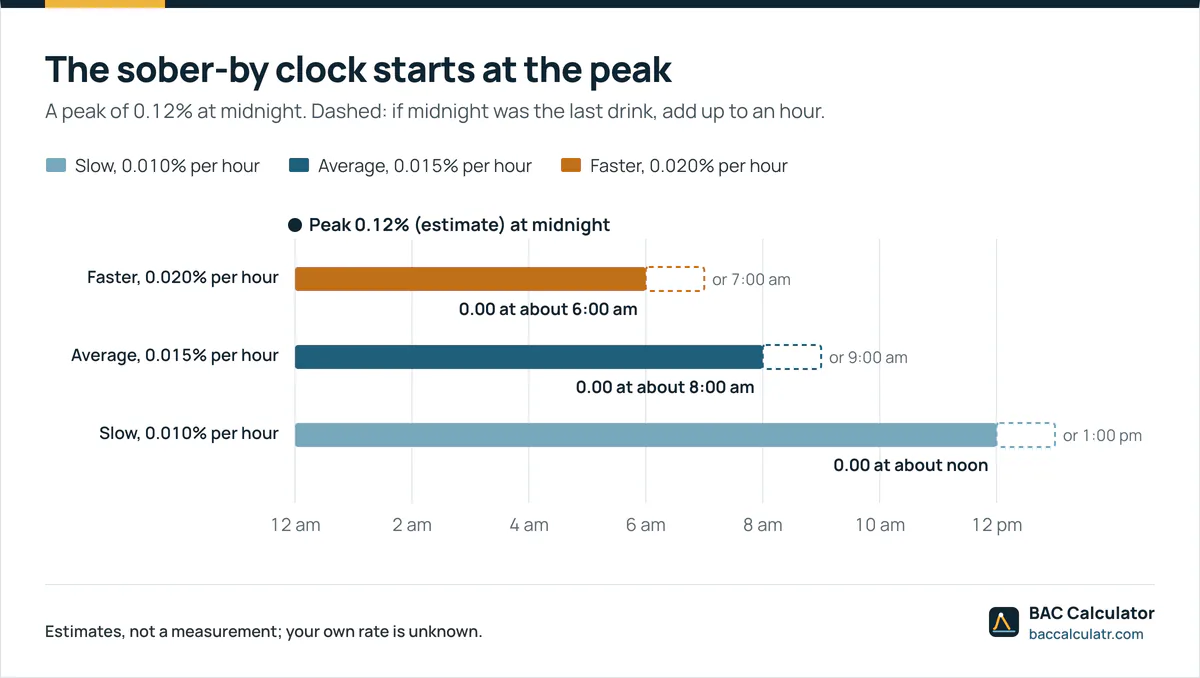
Say your estimated peak is 0.12% at midnight. At the average rate, 0.12 ÷ 0.015 = 8 hours, so the estimate reaches 0.00 at about 8:00 am. The faster rate gives 0.12 ÷ 0.020 = 6 hours, which is 6:00 am. The slow rate gives 0.12 ÷ 0.010 = 12 hours, which is noon. If midnight was your last drink rather than your peak, add up to an hour: 9:00 am, 7:00 am or 1:00 pm.
Where the 0.015% per hour figure comes from
The 0.015% per hour figure (15 mg per 100 mL every hour) is the average for moderate drinkers in Jones's 2010 review of elimination rates. Across the studies he pooled, hourly drops ran from 0.010% to 0.035%. On an empty stomach the rate runs about 0.010% to 0.015%, and after a meal about 0.015% to 0.020%. He also found the rate slightly faster in women. The top of the range comes from groups unlike a usual night out, so the table stops at 0.020%.
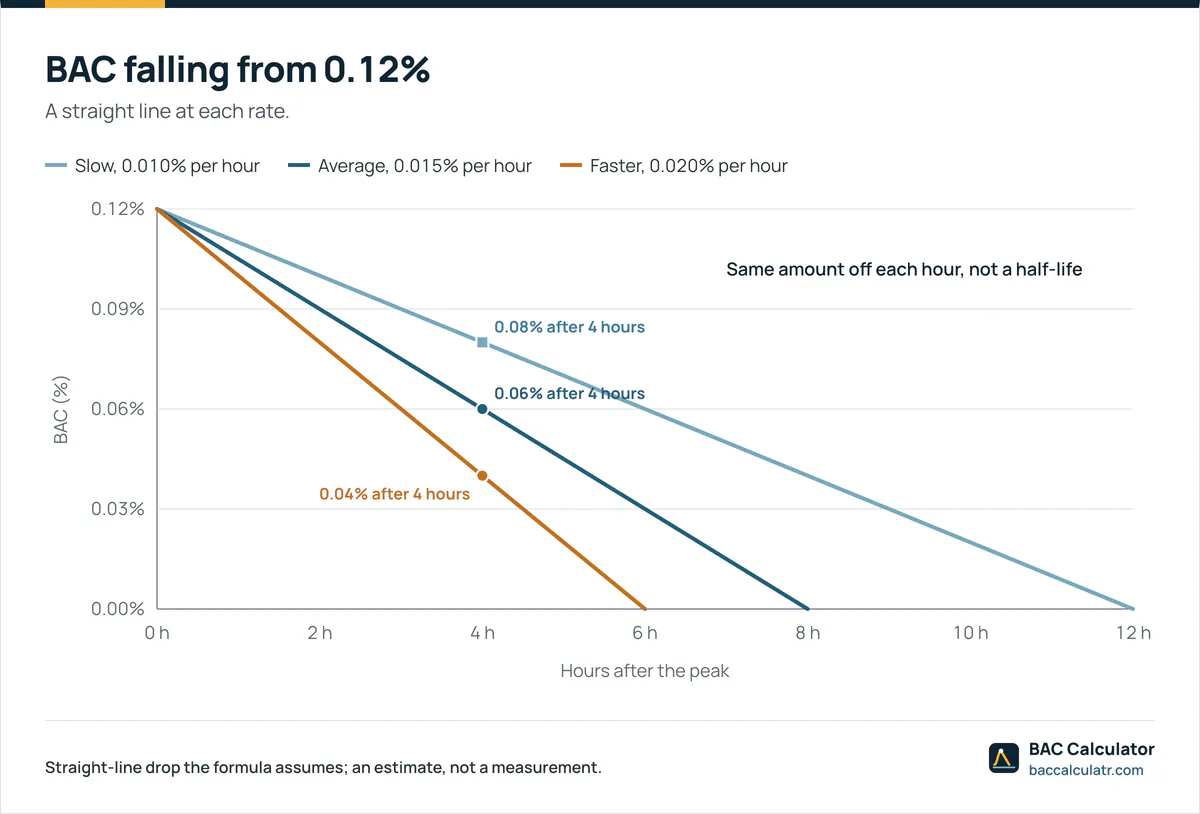
BAC has no half-life: it falls by about the same 0.015% every hour in a straight line. That straight drop also sets how many hours breath and blood tests can still find alcohol.
Does sleep help you sober up faster?
Sleep does not speed up how fast alcohol leaves your blood. In a small 1980 study, 6 fasting volunteers drank the same dose at 11 pm on four occasions. They stayed awake for two sessions and slept through two, giving blood samples over the next 8 hours. Madsen and Rossi's 1980 study found no significant difference in clearance between awake and asleep. The table reads the same whether you sleep or stay up.
Does time of day affect sobering up?
Time of day changed the time to zero in one lab study. In 2021, Rukmini and colleagues gave 20 adults aged 21 to 30 the same dose every 4 hours across a 40-hour lab routine. Breath alcohol took longest to return to zero after late-morning and afternoon doses, and peaks were higher at those times too. The hourly elimination rate showed no daily rhythm; only the peak and the time to zero did.
How long to sober up by the next morning
A late, high peak can leave alcohol in your blood well into the morning, as the midnight clock above shows.
Hangover driving tests at zero BAC
A hangover slowed simulated driving even with blood alcohol back at zero in a 2014 study by the Verster group. Its 42 social drinkers drove 100 km in a simulator the morning after an average of 10.2 drinks. Compared with a sober morning, their lane weaving rose by 1.9 cm and lapses went from 5.3 to 7.7, as the 2014 Psychopharmacology paper reports. Those who slept under 5 hours weaved the most.
UK breath tests on the morning after
The UK government's THINK campaign said in 2015 that about 5,500 people fail a breath test between 6 am and midday each year, around 15 a day. It also counted about 740 drink drive accidents reported in the morning in 2013. In THINK's November 2015 survey of 781 drivers in England and Wales, 28% believed sleep would make them safer to drive the next day. Another 33% trusted water and 21% a large meal. UK police can test breath, blood or urine, and each has its own UK drink driving limit.
Morning drink driving in Ireland
A Road Safety Authority study of Irish fatal collisions from 2008 to 2012 found that 11% of those involving a drinking driver happened between 7 and 11 in the morning. In a November 2018 release, Ireland's police force, An Garda Síochána, put 6% of drink driving arrests from 1 January to 22 November 2018 in that window. Sunday morning was the busiest, with 104 arrests, or 26% of them, according to the Garda and RSA 2018 release. Prof. Denis Cusack, who directs Ireland's Medical Bureau for Road Safety, put it plainly: only time clears alcohol from the body.
FAQ
Can I sober up in 4 hours?
Only from a low peak. In 4 hours, an estimated 0.04% peak reaches 0.00 at the slow rate, 0.06% at the average rate and 0.08% at the faster rate. Any higher peak needs more than 4 hours. The same table answers 2, 3 or 6 hours: find the hours in a column and read the peak on the left.
How long does being drunk last?
Alcohol stays in the blood until BAC reaches 0.00. At the average rate that takes about 6 hours 40 minutes from a 0.10% peak and 13 hours 20 minutes from 0.20%. The drunk feeling often ends sooner, which is why feeling sober can mislead, so count the hours, not the feeling.
Do women sober up slower than men?
Per hour, no: Jones's review found women clear alcohol slightly faster. But the same drinks give women a higher peak, for the body-water reasons behind the Widmark formula's r values. A higher peak sits further down the table, so the time to 0.00 from the same drinks can be longer.
Does the UK one-unit rule fit US drinks?
Not directly. THINK says the body takes about an hour to break down one UK unit, which holds 8 g of alcohol. On that rule, four pints of stronger beer can take about 12 hours. A US standard drink is 14 g, about 1.75 UK units, one of the gaps in standard drink sizes by country.
Do regular heavy drinkers clear alcohol faster?
Somewhat. Jones's review reports about 0.019% per hour in drivers arrested for drink driving, and 0.025% to 0.035% in people with alcohol dependence during detox. Tolerance does not lower the BAC reading itself, though: a 2012 study by Miller, Hays and Fillmore found BAC had no significant link to how much people usually drank.
Conclusion
A peak of 0.20% needs about 13 hours 20 minutes at the average rate and up to 20 hours at the slow one. A late night can run past noon. The BAC chart by weight uses the same straight drop, so its 3-hour cells sit 0.030% below its 1-hour cells. A hangover still slowed driving in tests at zero, and some tests find alcohol by-products after blood reads 0.00.