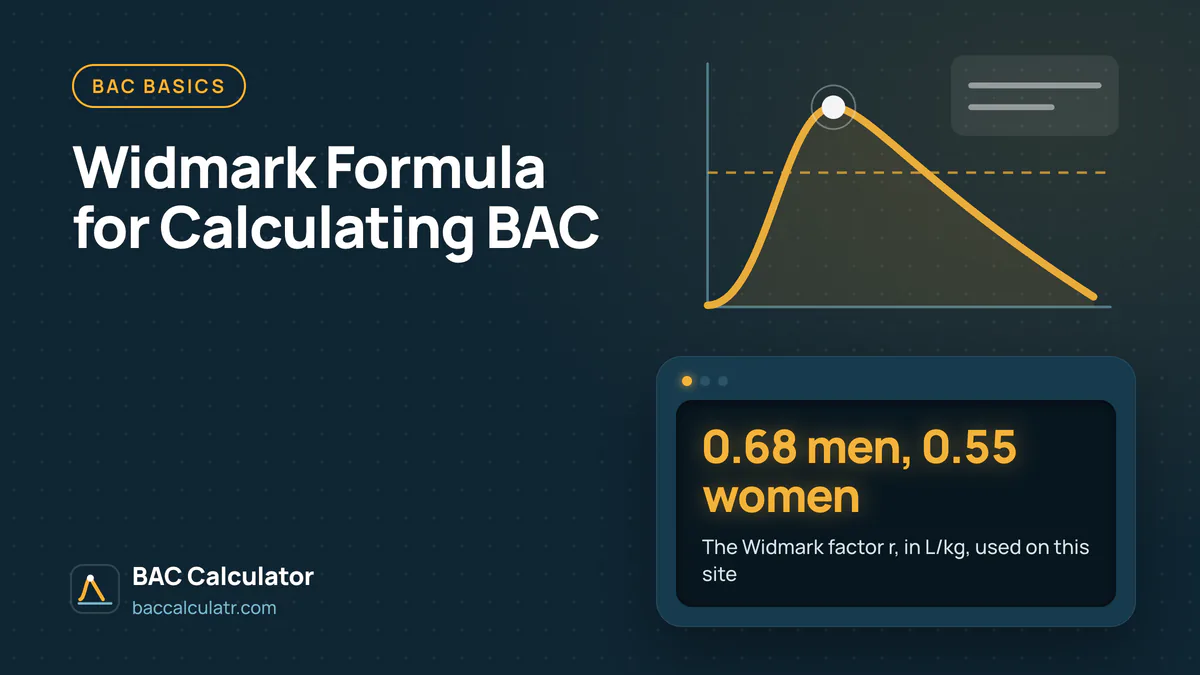
Widmark Formula for Calculating BAC
The Widmark formula estimates blood alcohol content (BAC) from four inputs: grams of alcohol, body weight, a body water factor called r, and hours since the first drink. Written out, BAC = A ÷ (W x r) x 100 − β x t. The usual constants are r 0.68 for men and r 0.55 for women, with 0.015% cleared each hour.
What each symbol in the equation stands for
The Widmark formula divides the alcohol you drank by the body water it spreads into, then takes off what your liver has cleared. US pages write it in percent.
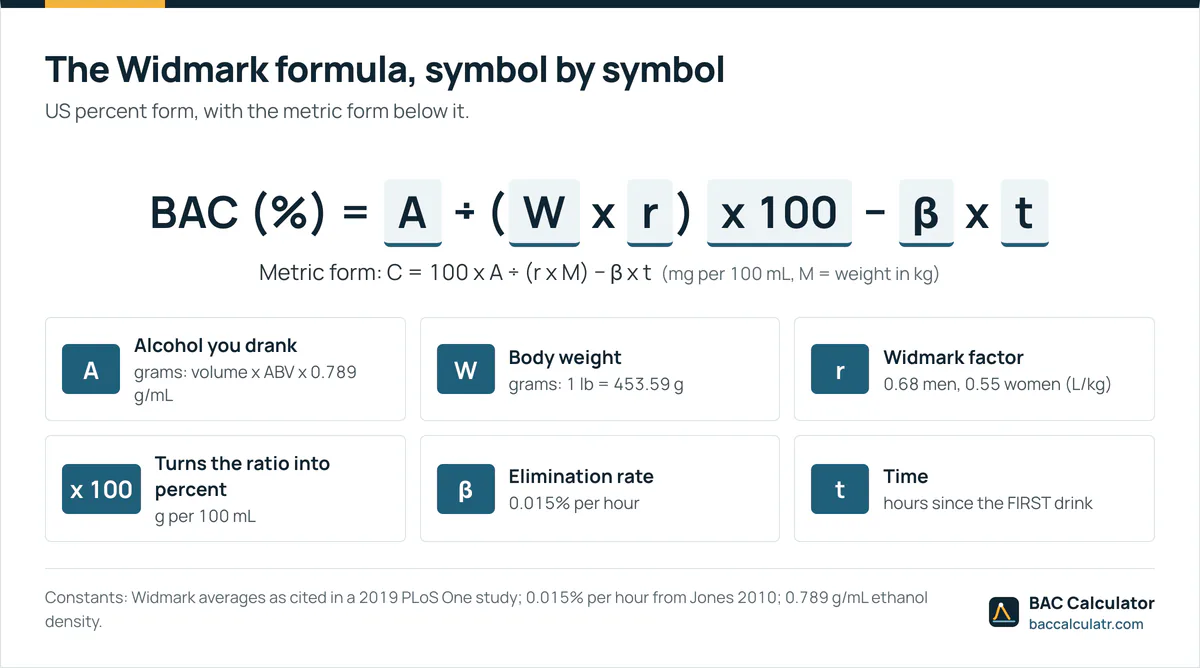
BAC (%) = A ÷ (W x r) x 100 − β x t.
The metric form takes kilograms and gives mg per 100 mL.
C = 100 x A ÷ (r x M) − β x t.
Both give the same number. With 14 g of alcohol, 70 kg and r 0.68, you get 0.0294% or 29.4 mg per 100 mL. Searle sets out the metric form in a 2015 paper on alcohol calculations. The BAC calculator on this site runs the same blood alcohol content formula with these constants.
Symbols, units and the values this site uses
The table lists each symbol in the blood alcohol content equation, its unit and the value this site uses. Assumptions: US percent form; the metric form uses M, weight in kg.
| Symbol | Meaning | Unit | Value used here |
|---|---|---|---|
| A | Alcohol you drank | grams (g) | volume x ABV x 0.789 g/mL |
| W | Body weight | grams (g) | 1 lb = 453.59 g |
| r | Widmark factor | L/kg | 0.68 men, 0.55 women |
| β | Elimination rate | % per hour | 0.015% per hour |
| t | Time since the first drink | hours | your hours |
Count t from the first drink, because the formula assumes full-rate clearing from the start.
Turning drinks into grams of alcohol
Grams of alcohol equal volume in mL times ABV times 0.789 g/mL, the density of ethanol. A US standard drink holds 14 g, about 0.6 fl oz of pure alcohol. Strong beers and large pours hold more, so work from the label; standard drink sizes by country lists non-US figures.
How to calculate a BAC by hand in pounds
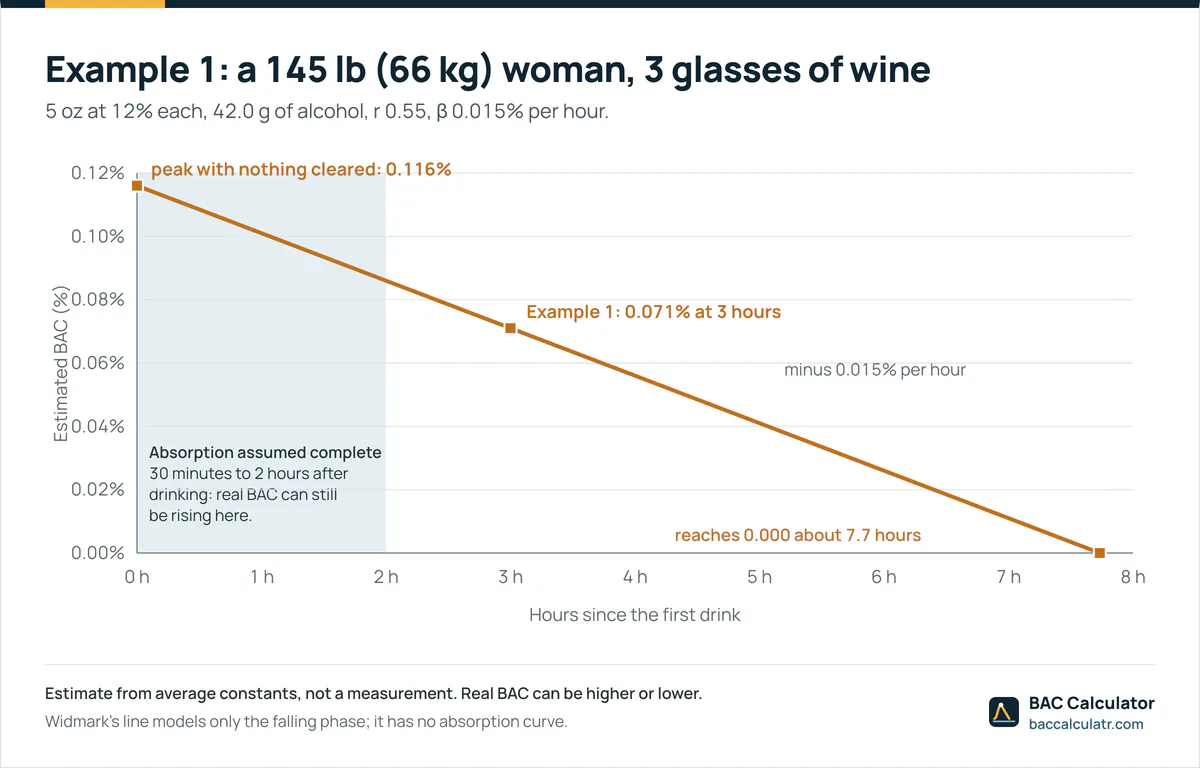
To calculate a BAC by hand, divide grams of alcohol by weight in grams times r, multiply by 100, then subtract 0.015 per hour. Picture a woman of 145 lb (66 kg) who drank 3 glasses of wine (5 oz at 12%) over 3 hours.
- Alcohol per glass: 5 oz x 0.12 = 0.6 fl oz of ethanol.
- Grams per glass: 0.6 fl oz x 29.5735 mL x 0.789 g/mL = 14.0 g, so 3 glasses = 42.0 g.
- Body weight: 145 lb x 453.59 g = 65,771 g.
- Peak with nothing cleared: 42.0 g ÷ (65,771 g x 0.55) x 100 = 0.116%.
- Alcohol cleared: 0.015% x 3 hours = 0.045%.
- Estimate at 3 hours: 0.116% − 0.045% = 0.071%.
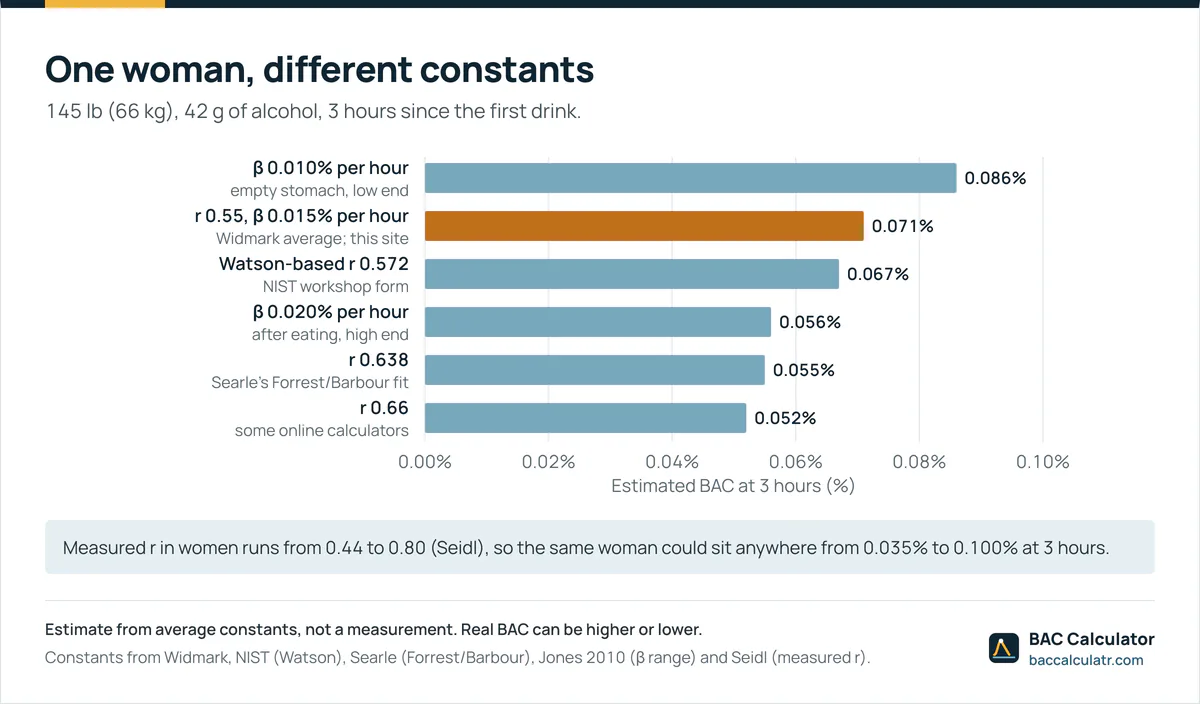
That 0.071% is an estimate built on average constants, not a measurement. Measured r in women runs from 0.44 to 0.80, so she could sit anywhere from 0.035% to 0.100% at 3 hours.
Run forward, her estimate reaches 0.000 about 7.7 hours after the first drink (0.116 ÷ 0.015). The same steps with 14 g in place of 42 g show how much one beer raises BAC.
Where the 5.14 shortcut comes from
Some US pages print BAC = fluid ounces of alcohol x 5.14 ÷ (pounds x r). The 5.14 is the unit change rolled into one number.
1 fl oz of ethanol = 29.5735 mL x 0.789 g/mL = 23.33 g. 23.33 g ÷ 453.59 g per lb x 100 = 5.14.
For the woman above, 1.8 fl oz x 5.14 ÷ (145 lb x 0.55) = 0.116%, the same peak.
Widmark formula in kilograms and mg per 100 mL
With weight in kilograms, the metric Widmark formula gives mg per 100 mL directly; divide by 1,000 for percent. Take a 90 kg (198 lb) man who drank 5 bottles of beer (330 mL at 5%) over 4 hours.
- Alcohol per bottle: 330 mL x 0.05 x 0.789 g/mL = 13.02 g.
- Total alcohol: 5 x 13.02 g = 65.1 g, about 4.6 US standard drinks.
- Peak: 100 x 65.1 g ÷ (0.68 x 90 kg) = 106.4 mg per 100 mL.
- Cleared: 15 mg per 100 mL x 4 hours = 60 mg per 100 mL.
- Estimate at 4 hours: 106.4 − 60 = 46.4 mg per 100 mL, or 0.046%.
The units map shows his result in each form, including mg per 100 mL, the unit of the UK drink driving limit. Assumptions: whole blood values.
| Form | His result | Where you see it |
|---|---|---|
| Percent (g per 100 mL) | 0.046% | US pages, the National Highway Traffic Safety Administration (NHTSA) (0.08% = 0.08 g per dL) |
| mg per 100 mL | 46 mg/100 mL | UK and Irish law |
| g per liter | 0.46 g/L | Lab reports, European papers |
BAC formula for women and men
The BAC formula male and female drinkers use is one equation, and only r changes: 0.55 for women and 0.68 for men. Those are Widmark's averages, cited in a 2019 PLoS One study of Widmark factors. With 42 g at 145 lb, the female BAC formula gives a peak of 0.116% and the male version 0.094%.
Why women's r is lower
Searle defines r as total body water divided by body mass, scaled by the water share of blood. Bone and fat hold little water. Women carry less body water per kilogram on average, so the same alcohol lands in a smaller pool.
Seidl and colleagues measured 256 women and 273 men and found r from 0.44 to 0.80 in women and 0.60 to 0.87 in men. Older German practice used rigid factors of 0.6 and 0.7.
Height and BMI versions of r
Later methods add height, and for men age, and fit measured data better. In Maskell's 2019 test on 173 men and 63 women, Watson's equations did best for men and the Forrest method for women.
Watson's body water for women, in liters, is −2.097 + 0.1069 x height (cm) + 0.2466 x weight (kg). Searle's simplification of the Forrest/Barbour method is r = 0.9367 − 0.01240 x BMI for women and r = 1.0181 − 0.01213 x BMI for men.
Each r below is run for the same woman. Assumptions: 145 lb (66 kg), 5 ft 5 in (165.1 cm), BMI 24.1, 42 g, β 0.015% per hour.
| Method | r (L/kg) | Peak BAC | BAC at 3 hours |
|---|---|---|---|
| Widmark average | 0.55 | 0.116% | 0.071% |
| Watson-based r (National Institute of Standards and Technology, NIST, workshop form) | 0.572 | 0.112% | 0.067% |
| Searle's Forrest/Barbour fit | 0.638 | 0.100% | 0.055% |
Posey and Mozayani note that BAC estimates often ignore these improvements.
Women's r by BMI
For women, r falls as BMI rises, so one fixed 0.55 fits some bodies better than others. Barbour's chart, which Searle's women's BMI line follows within 0.005, gives these values. Assumptions: women only; r in L/kg; Searle's line r = 0.9367 − 0.01240 x BMI.
| Women's BMI | r from Barbour's chart | r from Searle's BMI line |
|---|---|---|
| BMI 15.6 | 0.74 | 0.743 |
| BMI 20.1 | 0.69 | 0.687 |
| BMI 22.8 | 0.65 | 0.654 |
| BMI 25.3 | 0.62 | 0.623 |
| BMI 27.3 | 0.60 | 0.598 |
Forrest's own printed values for women run lower (0.61 to 0.53 at the three highest BMIs). Searle says those examples appear erroneous and warns that, for a woman of high BMI, they can shift the result by 25% or more.
The elimination term β in each unit
The β term is how far BAC falls each hour. This site takes off 0.015% each hour, the average for moderate drinkers, which is 15 mg per 100 mL or 0.15 g/L per hour in the metric form. Keep β in the same unit as the first term.
Searle writes β in mg% per hour (14.8 in his Gullberg case). Jones's 2010 review of elimination rates found hourly drops several times apart between drinkers, so changing β alone moves the pounds example this far. Assumptions: 145 lb woman, 42 g, r 0.55, peak 0.116%, 3 hours.
| β used | Context it matches | BAC at 3 hours |
|---|---|---|
| 0.010% per hour | empty stomach, low end | 0.086% |
| 0.015% per hour | moderate drinkers, average | 0.071% |
| 0.020% per hour | after eating, high end | 0.056% |
The equation has no term for coffee, water or a cold shower; only t lowers the result, the same point what does and does not sober you up makes.
Solving the formula backward
Rearranged, A = (BAC + β x t) x W x r ÷ 100 gives the grams behind a known BAC. From the woman's 0.071% at 3 hours:
A = (0.071 + 0.045) x 65,771 g x 0.55 ÷ 100 = 42 g, or 3 standard drinks.
A Washington State Patrol paper uses this algebra to estimate "any one of six variables". Its spread of about 20% (two standard deviations) applies to the number of drinks, not to BAC. Tables of drink counts that reach 0.08% by weight use the same rearrangement.
Why BAC calculators give different numbers
Calculators run one formula with different constants: r of 0.68/0.55, 0.70/0.60 or 0.73/0.66, and β of 0.015, 0.016 or 0.017 per hour. Assumptions: 145 lb (66 kg), 42 g of alcohol, 3 hours since the first drink.
| Constant set | Who uses it | Peak | At 3 hours |
|---|---|---|---|
| Woman, r 0.55, β 0.015 | Widmark averages; this site | 0.116% | 0.071% |
| Woman, r 0.66, β 0.015 | some online calculators | 0.097% | 0.052% |
| Man, r 0.68, β 0.015 | Widmark averages; this site | 0.094% | 0.049% |
| Man, r 0.73, β 0.015 | some online calculators | 0.087% | 0.042% |
For one woman, constants alone move the 3 hour result from 0.052% to 0.071%. Older state charts also used a smaller drink, a 12 oz beer at 4.2%, so they read lower. A tool that counts hours from the last drink, or skips elimination, gives a different number again.
What the Widmark formula leaves out
The formula assumes all the alcohol is already in your blood and ignores food, drinking pace and body make-up, so it can miss in either direction. Widmark's line models only the falling phase.
A NIST workshop deck states the rule: absorption is assumed complete somewhere between 30 minutes and 2 hours after a drink. Until then, BAC can still be rising toward its peak, which the subtraction step does not model.
Searle argues the error must be worked out case by case; he calls Gullberg's fixed percentage "mistaken". In a 2020 study of self-reported drinking, a Widmark-type equation tended to overestimate BAC. Drinking pace is the other blind spot, and fast drinking in games is the clearest case of it.
A formula result under a limit is not a test result. Breath and blood instruments do the measuring, and how many hours or days each test can still find alcohol varies with the sample. The legal BAC limit in each state is set by law, not by a calculation.
FAQ
How does blood alcohol work?
In formula terms, alcohol is absorbed from the gut, spreads through body water (the r term), and is cleared by your liver at a fairly steady rate (the β term). Even a slow liver gets through about 7 g an hour, half a US standard drink.
Does the formula work while alcohol is absorbing?
Not reliably. The formula assumes all the alcohol is absorbed, and the NIST workshop deck calls it of little help for drinks within the past hour. The real level can still be climbing when you run the numbers.
Why does the formula use weight, not height?
Widmark's r is one average per kilogram of body weight, so height never enters his version. Height still matters: in Watson's women's equation each centimeter adds 0.1069 L of body water at the same weight.
Is the Widmark formula accurate?
The arithmetic is exact, but r and β are averages and the formula assumes full absorption. Measured r of 0.44 to 0.80 in women alone moves the 3 hour estimate in the pounds example from 0.035% to 0.100%.
Conclusion
Swap in a height-based r or a different β and the same 42 g gives a different answer, as the tables above show. A BAC chart by weight shows the same math pre-run for common weights and drink counts.