How to Sober Up Fast
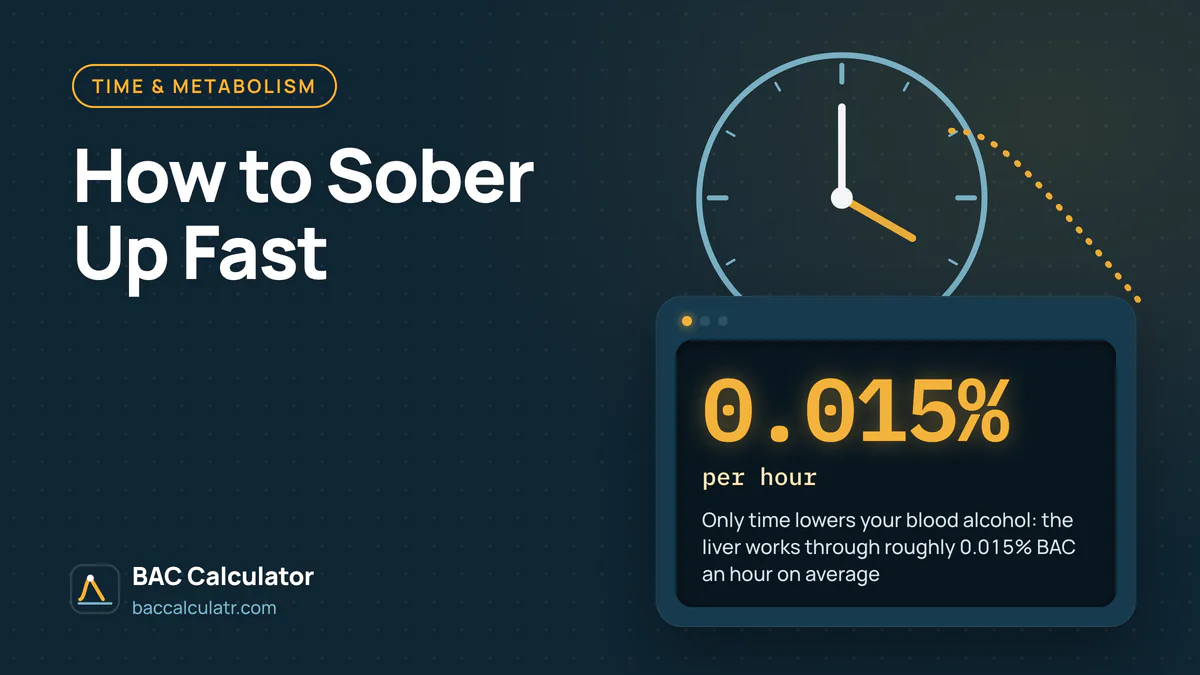
Only time lowers your blood alcohol, so how to sober up fast comes down to waiting while your liver works through roughly 0.015% BAC an hour on average. Coffee, cold showers and water can change how you feel, but not the number.
Can you sober up quickly?
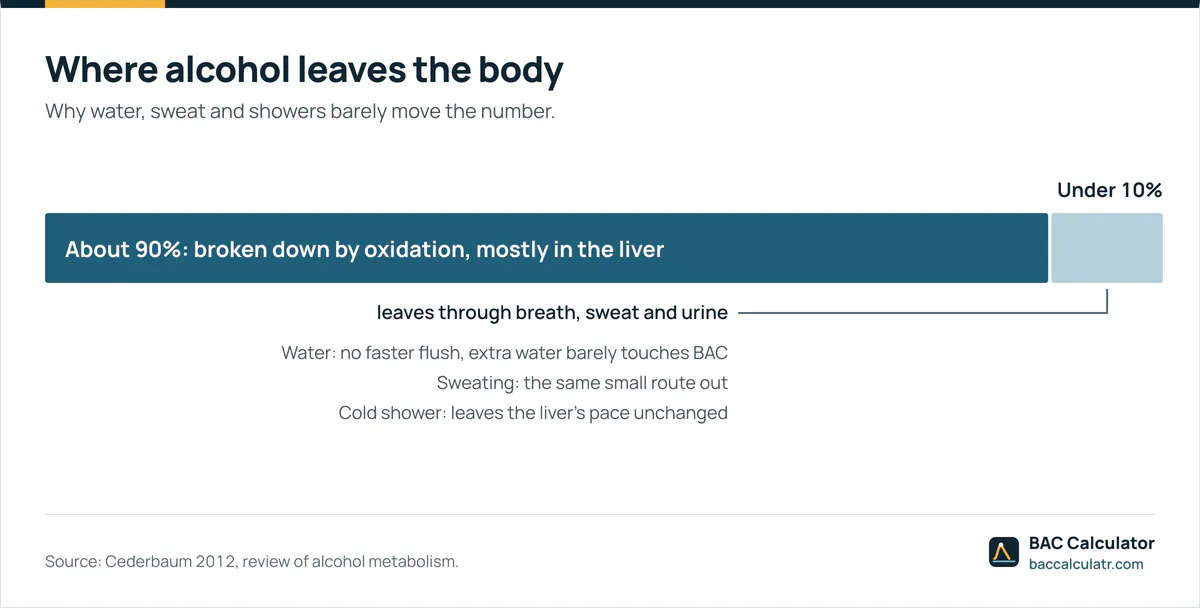
No. Cederbaum's review of alcohol metabolism finds that about 90% of the alcohol you drink is broken down by oxidation, mostly in the liver. Under 10% leaves through breath, sweat and urine. That split is why water, sweat and breath barely move the number.
At the low end the liver handles about 7 g of alcohol an hour, while a US standard drink holds 14 g. So one 12 oz beer at 5% gives your liver about two hours of work at that pace (14 g ÷ 7 g an hour = 2 hours). Your weight and sex decide how much one beer raises BAC, but the liver decides how fast it comes back down.
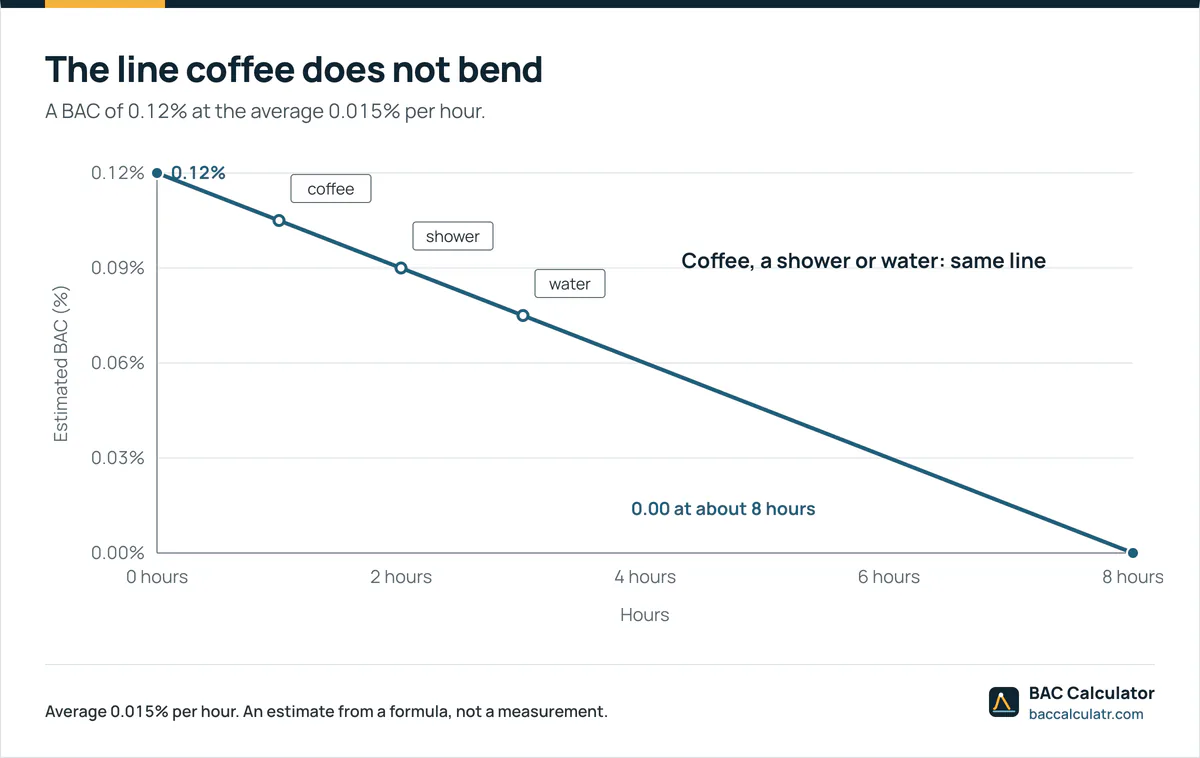
A BAC of 0.12% needs about 8 hours to reach 0.00 at the average rate (0.12 ÷ 0.015 = 8). Treat that 8 as a formula's average, since your own liver may run faster or slower. Bar pours often exceed one 14 g US drink, so the real wait tends to be longer than a drink count suggests. You can estimate your own BAC and time to 0.00 from your weight, drinks and hours. The hours to sober up at slow and fast rates show how far one person's clock can stretch.
How to sober up fast with coffee or showers
Does coffee sober you up from alcohol? No, and none of the tricks in the table below removes the wait, for the same reason: the liver sets the pace. The Widmark formula, the usual way to estimate BAC, has a term for hours since drinking began and none for coffee or showers.
| Belief | What actually happens | Source |
|---|---|---|
| Coffee, hot or black | Caffeine leaves alcohol's effects in place. You may feel alert and drink more. | Centers for Disease Control and Prevention (CDC) |
| Energy drink mixed with alcohol | In a trial with 26 adults, breath alcohol was unchanged by the energy drink, yet people felt less impaired. | Ferreira 2006 |
| Cold shower | A shower leaves the liver's pace unchanged, and the liver removes about 90% of alcohol by oxidation. | Cederbaum 2012 |
| Chugging water | Under 10% of alcohol leaves in urine, breath and sweat, so extra water barely touches BAC. | Cederbaum 2012 |
| Sweating it out in a sauna or dancing | Sweat belongs to that same small route out. The liver handles the rest. | Cederbaum 2012 |
| Eating a big meal | Food eaten first made the liver clear alcohol somewhat faster in a lab study, but the wait remains. | Ramchandani 2001 |
| Sleeping it off | In a small 1980 study, alcohol cleared no faster asleep than awake. You wake up with whatever the hours have not cleared. | Madsen 1980 |
| Throwing up | Alcohol already in the blood stays there, and the UK National Health Service (NHS) says not to try to make a drunk person sick. | NHS |
The lab studies behind these rows used small groups and set doses.
Does water lower blood alcohol?
No. Water cannot flush alcohol out, because less than a tenth of it leaves through urine, breath and sweat. Breath and urine tests pick up that small share, and how long alcohol shows up on breath and urine tests differs by test type.
Does eating food help you sober up?
Not in a way that replaces the wait, although food in the stomach does slow absorption. In a clamp study led by Ramchandani, alcohol went into a vein an hour after breakfast and was held steady. The meal raised the elimination rate by about a quarter to nearly a half compared with fasting. The authors credit more blood flow through the liver and busier alcohol-clearing enzymes. Men cleared more alcohol per hour than women, but the meal's boost was similar in both. Those results come from a lab drip, not a night out, so they give no count of hours saved.
Why you feel more sober than you are
Two things make you feel sharper while BAC is still high: caffeine's alertness, and the way people feel less drunk as BAC falls. Neither lowers the number. America's National Highway Traffic Safety Administration (NHTSA) warns that failing to recognize alcohol impairment is often a symptom of it. The feeling is the least reliable reading you have.
Does caffeine sober you up?
No. According to the CDC page on alcohol and caffeine, caffeine does not lessen what alcohol does to your body. Because it makes people feel alert, the alcohol may seem weaker, which can lead you to drink more and become more impaired. Three lab studies show the gap between feeling and performance.
| Study | People and dose | What changed with caffeine | What did not change |
|---|---|---|---|
| Ferreira 2006 | 26 adults, 0.6 or 1.0 g/kg of alcohol as vodka, plus an energy drink | People felt their coordination was less impaired | Breath alcohol; measured coordination and visual reaction time |
| Liguori 2001 | 15 adults dosed toward 0.08% breath alcohol, 200 or 400 mg of caffeine | Faster brake reaction in a driving simulator | Brake time stayed significantly slower than placebo; choice reaction time and body sway |
| Marczinski 2006 | 12 social drinkers, 0.65 g/kg of alcohol | A response that alcohol slowed got faster; people felt less drunk | The extra errors alcohol caused |
All three were small lab trials with a fixed alcohol dose, so they show direction, not how much caffeine changes a night out.
Liguori's team wrote that caffeine "will not completely counteract" alcohol impairment in a driver. On its own, without alcohol, caffeine made people rate themselves more alert and more jittery, yet it did not change their body sway or motor skills. The CDC adds that people who mix alcohol with energy drinks are more likely to report alcohol-impaired driving and riding with a driver who had been drinking.
Feeling less drunk as BAC falls
People feel less drunk on the way down than at the same BAC on the way up, a pattern called acute tolerance. Holland and Ferner's 2017 review pooled 26 studies. In 12 of 13 trials that asked, people rated themselves less intoxicated on the falling side. In 4 of 6 studies, they were more willing to drive. Yet driving skill tests were generally worse on the falling side at the same reading.
The grams of alcohol in your blood are the same either way, and what each BAC level does to you is set by that number. The Widmark formula has no term for tolerance either, so the drink count that makes someone feel drunk can differ between two people with the same BAC estimate.
What helps while your BAC drops
Stop drinking, sip water and stay put until a sober driver or a ride can take you.
- Stop drinking now. Alcohol you have already swallowed can keep raising BAC for a while. At its slowest, the liver gets through only about half a US drink an hour, which is why one drink per hour does not work.
- Sip water instead of the next drink. Every glass of water is a drink of alcohol you did not add.
- Do not drive, and do not ride with a driver who has been drinking. Book a taxi or ask a sober friend. The CDC says driving skills already decline below the legal BAC limit in each state, which is 0.08% everywhere except Utah at 0.05%.
- Stay with people you trust. Do not go off alone to sleep. The National Institute on Alcohol Abuse and Alcoholism (NIAAA) warns that an intoxicated person left alone risks injury from falling or choking.
- Get a lift if you feel ill. If you need a hospital, the NHS says: "Do not drive yourself to A&E." Call an ambulance or ask a sober person to take you.
How to sober someone up fast
You cannot sober a friend up faster, only keep them company while the liver works. A friend who will not wake, has a seizure or takes very slow breaths needs an ambulance. Ring 911 if you are in the US, or dial whatever local emergency number serves the place you are in. Then follow the alcohol poisoning signs and first steps while you wait.
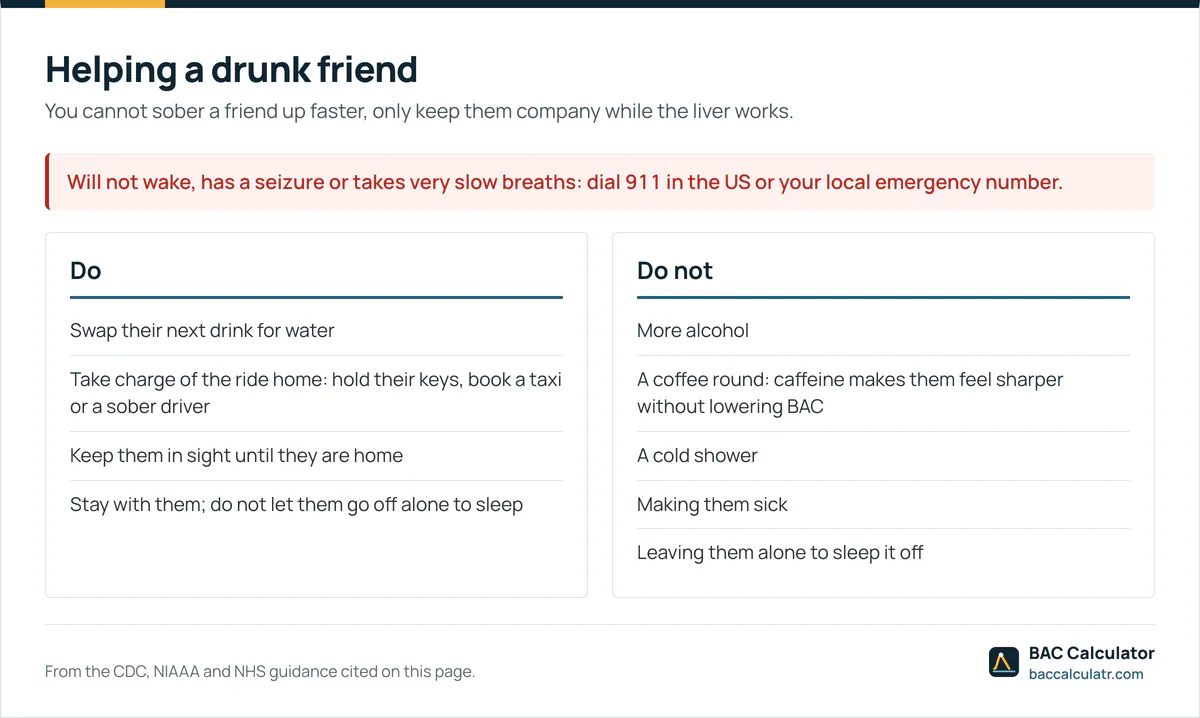
A friend who is drunk but awake and talking needs a few small jobs done.
- Swap their next drink for water.
- Skip the coffee round. Caffeine makes them feel sharper without lowering BAC, the CDC says, and may push them to drink more.
- Take charge of the ride home. Hold their keys and book a taxi or a sober driver.
- Keep them in sight until they are home.
FAQ
Is coffee or water better after drinking?
Neither lowers BAC: caffeine leaves alcohol's effects in place, and only a small share of alcohol leaves in urine. Water is the better swap for your next drink, because it adds no alcohol. Coffee can make you feel more alert than your BAC suggests, which the CDC says may lead to more drinking.
Can caffeine drinks dehydrate someone who has been drinking?
The NHS page on alcohol poisoning says coffee and other caffeine drinks can dehydrate people with alcohol poisoning, which is why it advises against them. The CDC lists losing more water from the body among the problems people who mix alcohol with energy drinks are more likely to report. That is a reported link, not a proven cause.
Does walking or exercise help you sober up?
Not in a way you can count on. Cederbaum's review calls the research on exercise unclear, with most studies finding only a small rise in how fast alcohol is cleared. At the low end the liver still clears only about 7 g of alcohol an hour, half a US standard drink.
What did the FDA say about caffeine in alcohol?
On 17 November 2010, the US Food and Drug Administration (FDA) warned four companies about their alcoholic malt beverages, calling the added caffeine an "unsafe food additive" in those drinks. Mixing has not gone away: about 1 in 5 college students report drinking alcohol mixed with caffeinated energy drinks in the past year, according to the CDC.
Conclusion
Stopping now is the only step that keeps the wait from growing. Each extra US drink adds about two hours of liver work at the slow 7 g an hour pace. How long the rest takes depends on where you started, a figure the BAC chart by weight gives for common body sizes and drink counts.